

Fire protection constructions in timber construction with updated DIN 4102-4
Safe and healthy building with
Rigidur H gypsum fibreboards
Those who prioritise healthy living environments and sustainable construction will find that a combination of wood and gypsum building materials offers the best of both worlds. This is because these two natural building materials have a lot in common in terms of human well-being, structural functionality, and environmental performance.
Healthy building materials create a comfortable indoor climate
Rigidur H gypsum fibreboards are made from natural gypsum and recycled paper fibres for reinforcement, and are completely free from adhesives and binders. The independent Institute for Building Biology Rosenheim GmbH (IBR) has tested and evaluated them for pollutants and environmental compatibility, awarding them the seal of approval as a healthy living building material. Furthermore, Rigidur H gypsum fibreboards are included in the "Healthier Buildings" construction directory and are endorsed with the Sentinel House logo.
Rigidur gypsum fibreboards have a positive effect on the indoor climate. For example, they absorb excess moisture from rooms such as bathrooms and kitchens and release it into the air when it is dry. This proven ability to absorb water vapour is as effective as that of clay plasters, which are renowned for their moisture-balancing properties.
All advantages of Rigidur gypsum fibreboards...
Application of construction systems in accordance with the Model Building Code (MBO)
According to § 3 MBO, structural facilities must be "arranged, constructed, modified, and maintained in such a way that public safety and order, particularly concerning life, health, and natural resources, are not endangered." This includes not only structural stability and usability, but also fire protection for buildings, which are specified in more detail in § 14 and §§ 26 ff. Components subject to fire protection requirements must be proven applicable. These proofs of applicability for components, referred to as "building types" according to § 16a, follow a kind of hierarchy:
1. Building types for which technical rules exist, e.g., normatively regulated constructions (for fire protection DIN 4102-4)
2. Building types for which technical rules do not exist.
These are further divided into:
a) Building types for which there is a general building type approval (aBG), or
b) Building types for which a project-specific building type approval (vBG) has been granted
3. Building types that can be tested and evaluated according to recognised testing procedures may, instead of an aBG, also be proven and applied through a general building inspection certificate (abP).
Technical building regulations
Through § 85a, the MBO enables the highest building authorities of the federal states to specify the basic requirements of § 3 via technical building regulations. This is achieved through the administrative regulation Technical Building Regulations, which is also published as a nationwide model (MVV TB) by the DIBt. Technical building regulations for building types/components that must meet fire protection requirements are addressed in Part C 4.1 and subsequent sections. Timber construction occupies a special position within these regulations.
Components/building types that must be fire-resistant may be proven and applied using an abP, which indicates the fire resistance class F 30-B. If further requirements are imposed, these components/building types fall under the scope of the Model Timber Construction Guideline (MHolzBauRL) according to A 2.2.1.4. These components must be highly fire-resistant at a minimum and are commonly referred to as F 60 or F 90. To meet the MHolzBauRL requirements, fire-resistant cladding made of gypsum and/or gypsum fibreboards is required. Additionally, the fire resistance of these components must be proven, which can be achieved by complying with the technical standard DIN 4102-4 or by obtaining general building type approvals (aBG).
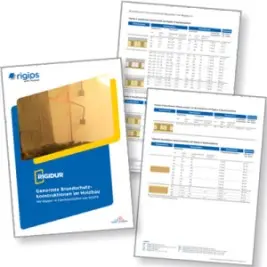
NEW NOW: The revised technical rule DIN 4102-4 "Fire behaviour of building materials and components – Part 4: Compilation and application of classified building materials, components and special components" offers an extensive selection of classified fire protection constructions for timber construction with Rigidur H gypsum fibreboards for the first time. These are presented in the following brochure in a clear, tabular format.
Fire protection of the normative
components with Rigidur H
This document is a compilation of classified timber construction wall, roof and ceiling structures according to DIN 4102-4:2025-06, with Rigidur H gypsum fibreboard cladding.
Standardised fire protection constructions in timber construction (PDF)...