


Roof
Expanding roof space with drywall: Solutions, information and systems
For sloped ceilings, knee walls, ceilings, and floors: our expansion systems provide the ideal solution for converting your attic. Find out which products are suitable for your construction project.
Flexible and individual design of the roof space
Whether you want to create additional living space, a comfortable workspace or a playroom for children: expanding the roof space opens up many possibilities for utilising the newly gained space — easily, safely and flexibly with RIGIPS.
Drywall construction using gypsum (fiber) boards provides the best conditions for measures within the scope of roof conversions in new buildings and renovated old buildings. The material is lightweight and easy to work with.
With Rigips expansion solutions, you can create new living spaces in single-family or multi-family homes that impress with exceptional comfort.
The shape of the roof significantly affects the potential for roof space conversion. Classic single-family and multi-family homes usually have a pitched roof. These roofs are ideal for skilfully utilising the space for additional living and working areas through dry interior construction. With Rigips, you can find the perfect solution all in one place.
Our expansion systems are just as suitable for walls and sloped ceilings as they are for collar beam ceilings and floors. You have access to a wide variety of drywall boards – for optimal sound, fire, or moisture protection. In addition, we offer you the complete range of accessories, including profiles, joint fillers, quick-assembly screws, and anchors.


Rigips System Search & RiKS Calculation Service
How many of our high-quality construction boards do you need for your project? Use our practical planning tool to calculate the exact quantity and type of material required.
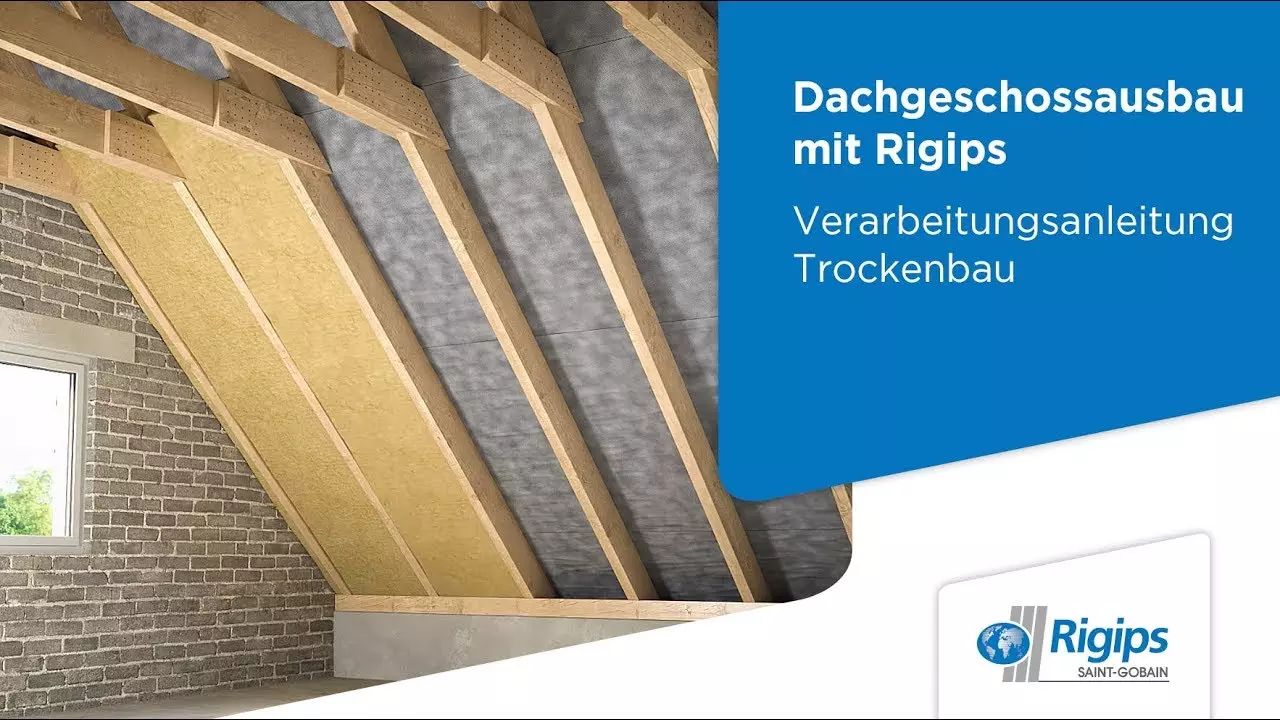
Video: install boards on sloping ceilings
Watch this video to learn how to re-board sloped ceilings safely and systematically. The step-by-step animations will teach you everything you need to know.
Predestined for roof interior construction: Die Dicke
When creating a new living space under a roof, partition walls usually need to be built and the sloping ceilings must be neatly and reliably clad. Robust solutions such as the special Die Dicke drywall board from Rigips are ideal for this purpose. It is characterised by its high stability and its excellent sound and fire protection properties. Die Dicke is safe and easy to work with, offering high cost-effectiveness as it enables constructions with a fire resistance duration of F 30, even when installed in a single layer.
These properties make Die Dicke ideal for constructing high-performance partition walls and knee walls, the latter of which are integrated storage and shelving spaces within sloping ceilings. The low weight of this drywall board makes it easy to handle in angled spaces and under sloping ceilings. It is therefore predestined for attic construction.
Robust and durable in roof construction, without dowels: Rigips Habito
The massive drywall board Rigips Habito is also excellently suited for attic construction. It offers several advantages: even heavy loads can be attached to a stud wall clad with this innovative board without dowels, using only a screwdriver and screws.
Rigips Habito allows for the secure attachment of loads of up to 30 kilograms per screw. Shelves, flat-screen TVs, or cabinets can thus be mounted quickly and securely. The disadvantages of conventional solid construction methods are a thing of the past: no drill holes, no drilling dust, and other annoying side effects of attic construction.
Rigips Habito is also extremely resistant to mechanical stress. The robust surface of the board is up to 50 percent more durable than conventional plaster surfaces. Impacts and bumps, for example, from chair backs, vacuum cleaners, or doors, affect it far less than many masonry walls. So, whether a children's room or a hobby room is to be created in the newly converted attic, walls and sloping ceilings clad with Rigips Habito can withstand a lot!
Substructure recommended for sloping ceilings
For installation on sloping ceilings, construction professionals recommend using a profile substructure rather than attaching the boards directly to the rafters. The substructure compensates for any excessively large distances between the rafters. It also prevents future cracking caused by movements in the roof structure.
When attaching the metal profiles to the rafters, ensure you compensate for any irregularities (for example, use the Rigips adjustment swing bracket or the U-direct hanger). The rafters can also be left visible as design elements, of course. If this is the case, cladding with Rigips boards should only be applied between the rafters. In this case, external rafter insulation is recommended as a sensible insulation measure.
Peace
When it comes to using a roof as a home office, effective soundproofing is of the utmost importance. A quiet environment is essential for concentration and well-being, whether you're in the office or at home.
Safety
People value safety. That’s why we use certified security for our components and systems. This is especially important if the newly created space under the roof is to be used as a children's playroom.
Time
In a fast-paced world, builders and planners who address this factor with expertise and the right tools stand out. We offer you gypsum boards and systems that can be installed quickly, flexibly, and with minimal effort. This saves you time that you can use elsewhere.
Indoor Climate
A healthy indoor climate is essential for human well-being, whether at home or at work. Our component solutions can help you achieve this.

