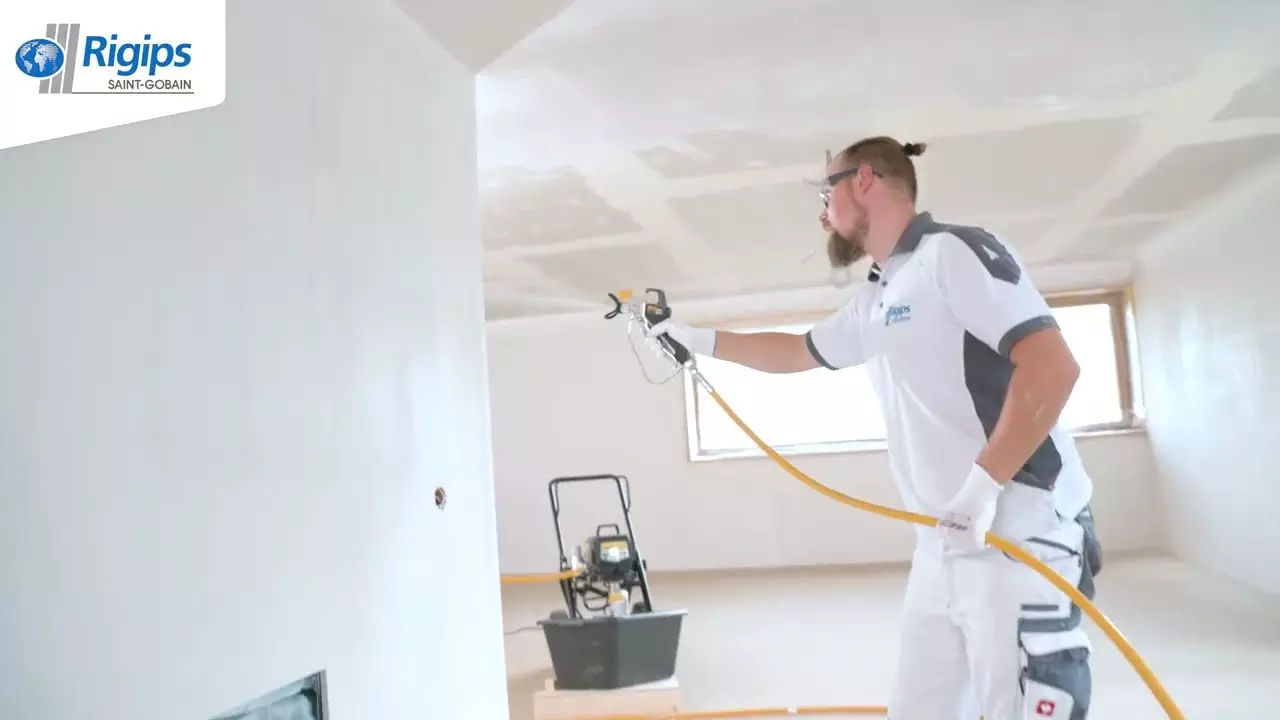

Surface quality
RIGIPS stands for the highest surface quality.
The evaluation of aesthetic surfaces is often subjective, depending on the viewer's perspective. However, this assessment should be conducted objectively, according to clearly defined quality levels. RIGIPS offers solutions for achieving quality levels 1 to 4.
Quality Level 1 (basic jointing)
For surfaces that do not have any visual (decorative) requirements, a basic jointing (Q1) is sufficient.
Jointing according to Quality Level 1 includes:
- filling the joints between the gypsum boards, and
- covering the visible parts of the fastening elements, and
- removing excess jointing material. Tool-related marks, grooves, and ridges are permissible.
Quality Level 2 (standard jointing)
Jointing according to Quality Level 2 (Q2) is the standard jointing. It meets the usual requirements for wall and ceiling surfaces. The goal of jointing is to create seamless transitions in the joint areas of the board surface. The same applies to fastening elements, inner and outer corners, and connections.
Jointing according to Quality Level 2 includes:
- basic jointing (Q1), and
- subsequent jointing (fine jointing, finishing) to achieve a seamless transition to the board surface.
Quality Level 3 (special jointing)
If higher requirements are placed on the jointed surface, additional measures beyond basic and standard jointing are necessary.
Jointing according to Quality Level 3 includes:
- standard jointing (Q2) with
- wider jointing of the seams, as well as precise smoothing of the remaining cardboard surface to seal pores with jointing material.
Quality Level 4 (special jointing)
To meet the highest requirements for the jointed surface, either a full-surface jointing or a complete skim coating of the entire surface is available. Unlike Q3 jointing, the entire cardboard surface is covered with a continuous layer of jointing or plaster material.
Quality Level 4 includes:
- standard jointing (Q2), and
- if necessary, wide jointing of the seams,
- wide jointing of the seams as well as full-surface coating and smoothing of the entire surface with a suitable material (layer thickness greater than 1 mm).
Source: Federal Association of the Gypsum Industry e.V., Information Sheet 2: Jointing of Gypsum Boards Surface Qualities
Surface design in interior spaces
In practice, the evaluation of the aesthetics and quality of a construction, as mentioned, is based on subjective criteria, which, in addition to the flatness of the component, primarily focus on visual features such as markings on the cardboard surface and joint outlines.
In contrast, there is an objective evaluation that must be carried out in accordance with IGG leaflet 2 "Jointing of gypsum boards surface qualities." This document divides the various quality classes into levels ranging from Q1 (basic jointing for surfaces without visual requirements) to Q4 (full-surface special jointing for surfaces with the highest requirements) – a detailed explanation of these quality levels can be found further down on this page (jump to explanation).
As a key participant in a construction project, you must consider the desired quality of a wall, floor, or ceiling construction made of gypsum boards during the planning phase of a project.
Aesthetic surfaces with RIGIPS: our offer
The creation of high-quality surfaces places the highest demands on craftsmanship in modern dry interior construction. Moreover, these measures are extremely labor- and time-intensive. At the same time, this exact quality is often demanded by customers or clients. Therefore, it is essential to use products that make your work as effortless as possible. Rigips products help you achieve your goals flexibly, cost-effectively, and quickly.
We also offer useful components for edge processing. Rigips AquaBead and AquaBead L-Trim, as well as the flexible Rigips AquaBead Flex PRO edge protection, consist of a robust plastic core with a paper coating and are equipped with a starch-based adhesive on the back. This unique technology enables fast, economical work and guarantees permanently stable, perfect edges.
In addition to the specialized solutions presented, we offer you other high-quality products that meet the highest standards and support you in achieving the desired quality level. Discover our comprehensive range of joint fillers, fillers, and accessories.


Jointing of gypsum boards: What surface quality levels are available?
As is often the case, the quality of surfaces is determined by their finish. To assess this subjective perception, clearly defined quality levels according to IGG leaflet 2 "Jointing of gypsum boards surface qualities". These levels are based on criteria that can be used to classify a construction.
However, if special lighting conditions are used for the assessment or acceptance of jointed surfaces, such as raking light, natural light or artificial lighting, the client must ensure that comparable lighting conditions are present during the execution of the jointing work. As lighting conditions are generally not constant, it is only possible to make a clear assessment of drywall work in a lighting situation that has been defined prior to the jointing work being carried out. This lighting situation must therefore be agreed upon in the contract.
Quality Level 1 (Q1)
This level always involves basic jointing for surfaces without optical requirements. Overall, this quality level includes the following steps:
- Filling the joint gaps.
- Covering the visible parts of the fastening elements.
- If necessary, embedding reinforcement strips.
- Removing excess jointing material (protrusions, ridges, etc.).
- The surface meets the requirements for: coverings and coatings made of tiles and boards.
Quality Level 2 (Q2)
When we talk about Q2, we mean basic jointing for surfaces without optical requirements. This level includes:
- Basic jointing according to Q1.
- Subsequent jointing (fine jointing, finishing) to achieve a seamless transition to the board surface.
- If necessary, sanding the jointed surface; markings, especially under raking light, cannot be completely excluded.
- The surface meets the requirements for: medium and coarse textured wall coverings, e.g., woodchip wallpaper; matte and filling paints/coatings, e.g., dispersion paints; top coats with grain size > 1 mm.
Quality Level 3 (Q3)
Quality Level 3 is a special jointing for surfaces with higher requirements regarding usability and flatness tolerances. The criteria for this classification are:
- Standard jointing according to Q2.
- Wider jointing of the gaps and precise smoothing of the remaining cardboard surface to seal pores with jointing material.
- Even with special jointing, markings visible under raking light cannot be completely excluded and are permissible according to VOB/C, DIN 18350 (future DIN 18340), section 3.1.2 [7].
- The surface meets the requirements for: finely textured wall coverings; matte, non-textured paints/coatings; top coats with grain size < 1 mm, provided they are approved by the manufacturer.
Quality Level 4 (Q4)
The highest quality is referred to as Quality Level 4 and includes full-surface special jointing for surfaces with the highest requirements. This means:
- Standard jointing according to Q2.
- Wider jointing of the gaps.
- Full-surface coating and smoothing of the entire surface up to 3 mm with a suitable finishing material, e.g., Rigips ProMix Plus.
- Markings under raking light are minimized within the scope of craftsmanship possibilities.
- Surface suitability: smooth or textured wall coverings with gloss, e.g., metal or vinyl wallpaper; glazes or paints/coatings up to medium gloss; Stuccolustro or other high-quality smoothing techniques.
Rigips System Search & RiKS Calculation Service
How much of our high-quality joint fillers, filler compounds, and accessories do you need for your construction project? Use our practical planning tool to calculate the exact quantity and type of material required.
Rigips® ProMix Airless - Gebrauchsfertige Spritzspachtelmasse für maschinelle Erstellung von Q2 - Q4