

Earthquake-resistant construction
Safe construction in earthquake-prone areas
Earthquakes in Germany
Fortunately, most people in Germany only know images of buildings or even entire cities destroyed by earthquakes from the news. However, larger earthquakes can also occur here, particularly in North Rhine-Westphalia and Baden-Württemberg, the regions most at risk. Parts of Bavaria and Thuringia are also affected.
However, the occurrence of earthquakes does not necessarily mean severe damage or collapsing buildings, as there are ways to build earthquake-resistant structures. In Germany, DIN 4149 provides a standard that allows structural facilities to be designed to withstand a defined design earthquake and still maintain sufficient residual load-bearing capacity after the quake.
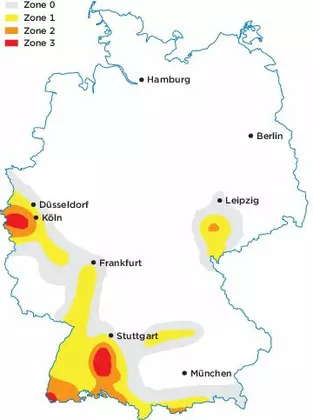
Zone 0 = intensity 6.0 - 6.5
- primarily noticeable inside buildings, partially outside
- noticeable shaking of the entire building, hanging objects swing significantly, some items fall over
- hairline cracks in some walls, occasional breaking of glass panes, plaster may fall off
Zone 1 = intensity 6.5 - 7.0
- clearly noticeable inside and outside buildings, some people are startled and flee outdoors
- falling objects, furniture shifts
- cracks and breakouts in walls and plaster, chimneys may collapse
Zone 2 = intensity 7.0 - 7.5
- inside buildings, people may lose their balance, many are startled and flee outdoors
- furniture may topple over, water splashes out of pools
- wall cracks, collapsing chimneys
Zone 3 = intensity ≥ 7.5
- inside and outside buildings, people lose their balance
- furniture falls over, ground vibrations may be visible, gravestones topple
- some buildings may partially collapse
Description of earthquake zones
The map above corresponds to the representation in DIN 4149:2005-04, Figure 2 "Earthquake Zones of the Federal Republic of Germany." The earthquake zones have been assigned intensity intervals based on the European Macroseismic Scale (EMS). The descriptions listed alongside represent a highly condensed excerpt from the original English text and are intended solely for illustration purposes.
In addition to the earthquake zone itself, ground conditions, the building site's geology and soil properties also play a significant role. It is therefore essential that these boundary conditions are determined and defined by specialists.
Legal and normative framework
According to §3 and §12 of the Model Building Code, buildings must be capable of safely and without damage absorbing the stresses arising from their own weight, live loads, wind or snow. This requirement also applies in the unlikely event of a strong earthquake in Germany. To ensure the stability of buildings and structural components in the event of an earthquake, the current standard in Germany is DIN 4149:2005-04 "Buildings in German Earthquake Zones," which deals with load assumptions as well as the design and execution of typical high-rise buildings. As part of the harmonization of European standards, it is expected that Eurocode 8 "Design of Structures for Earthquake Resistance" will replace this national standard in the foreseeable future.
The contents of both sets of standards are largely identical and state that structural facilities must be designed and constructed to withstand a defined design earthquake and still maintain sufficient residual load-bearing capacity after the quake. Non-load-bearing components must be designed so that they do not pose a danger to people in the event of an earthquake.
In essence, this means:
- human life must be protected
- damage must be limited
- important structures for public safety must remain functional
Principles of earthquake-resistant construction
In order to design an earthquake-resistant building, it is crucial to understand how buildings and structural components behave under seismic stress. DIN 4149 provides recommendations for the design of earthquake-resistant structures, which are simplified as "regularity in layout and elevation." Regular structures are significantly more resistant to earthquakes than irregular ones. The most important criteria are listed below:
- Choosing a simple structural system with clear load transfer paths
- Using structural components with similar stiffness and load-bearing properties
- Preferring ductile constructions with high energy dissipation, i.e., earthquake forces are converted into structural deformation without loss of load-bearing capacity
- Avoiding large masses in the upper floors
- Planning compact and symmetrical layouts, avoiding highly segmented shapes
- Layouts with high torsional resistance
- Continuous arrangement of bracing components from the foundation to the roof
- Avoiding large setbacks between individual floors
Additionally, the following fundamental principles should be considered in the static analysis to ensure that these design rules form a solid basis:
- Primarily horizontal accelerations from the ground activate the entire load-bearing structure of the building
- Unlike quasi-static load assumptions for self-weight and live loads, the actual dynamic forces of an earthquake show significantly greater variations compared to the assumed substitute loads
- The quasi-static design of a structure is characterized by a "safe-side" underestimation of stiffness; in the case of earthquakes, stiffness must be estimated as accurately as possible to determine realistic substitute loads
In "Technik aktuell Nr. 70 Earthquake Safety with Rigips," the legal and normative foundations for the design of earthquake-resistant components are described in greater detail. In addition to guidelines for calculating load-bearing and bracing components in timber construction, constructive measures for the earthquake-resistant execution of non-load-bearing internal partitions and suspended ceilings are also provided.
Rigips products for use in earthquake zones
Timber construction, especially timber board construction, is a construction method that is particularly well-suited for potential earthquake stress. This method involves load-bearing and bracing components that can absorb earthquake forces and convert them into structural deformation without collapsing. This behaviour is commonly referred to as energy dissipation.
An essential component of timber boards is the load-bearing and bracing sheathing, which is made from board materials. DIN 4149 provides examples of unrestrictedly applicable sheathing materials for timber boards. While these are mostly wood-based boards, Rigips products are also unrestrictedly applicable due to two general construction approvals:
- Z-9.1-898 regulates the use of the gypsum fiberboard Rigidur H
- Z-9.1-830 regulates the use of the Rigips fire protection board RF
Rigips product - technical properties
Rigidur H gypsum fiberboard according to DIN EN 15283-2
- Earthquake-suitable according to Z-9.1-898
- Ductility class 2 according to DIN 4149
- Behavior factor q ≤ 2.5
Habito; fire protection board RF
- Gypsum board type GKF according to DIN 18180 or type DF according to DIN EN 520
- Earthquake-suitable according to Z-9.1-830
- Ductility class 1 or 2 according to DIN 4149
- Behavior factor q ≤ 2.0
Non-load-bearing internal partitions
Even non-load-bearing components contribute to the behavior of a building during an earthquake. The higher the total mass of the building, the higher the oscillating mass, and thus the substitute loads to be considered in the event of an earthquake. Lightweight interior construction therefore offers two important advantages:
- reducing the oscillating mass, and
- damping the dynamic response
Non-load-bearing internal partitions with a height of more than 3.50 m must be specifically verified according to DIN 4149. The verification can be simplified as a comparison of the stress from earthquake substitute loads and the service loads according to DIN 4103-1.
Suspended ceilings
Suspended ceilings can be subjected to additional stresses during an earthquake. These can include horizontal ceiling displacements as well as vertical suction and pressure loads. It must be demonstrated that the suspended ceiling does not pose a risk to people under the design earthquake impact and does not adversely affect the behavior of load-bearing components. Beyond the actual static design, the following constructive measures are required:
- Construction of a substructure with base and load profiles (arranged at different heights)
- Planning the suspension height as low as possible
- Using hangers of load class 0.4 kN according to DIN 18168
- Always screwing hangers and profile connectors to the substructure
- Directly attaching additional loads to the raw ceiling
- Using fastening materials suitable for seismic stress
- Avoiding the introduction of vertical ceiling loads into adjacent walls
- Choosing sheathing with the lowest possible self-weight
- Arranging diagonal bracing between the substructure and the raw ceiling
- Pressure-resistant connection to adjacent walls without introducing tensile forces