
Moisture applications
Videos
Moisture protection
Moisture protection in interior construction: solutions, applications, and information
The right solution for every need: our moisture-resistant gypsum boards have been specially developed for use in damp and wet rooms.
Optimal moisture protection in drywall construction with gypsum boards
Damp and wet rooms place high demands on wall and ceiling constructions. The building materials used must be both moisture- and water-resistant. Additionally, certain standards and legal requirements must be taken into account. RIGIPS offers a wide range of moisture-resistant boards and accessories that are perfectly tailored to the respective requirements.
Damp rooms: the construction regulations
Specialist planners, architects and contractors face particular challenges when designing and constructing cost-effective, safe and durable buildings in damp and wet environments. According to § 13 of the MBO's general building regulations, structural facilities must be designed and arranged in such a way that no hazards or unreasonable impairments arise due to water, moisture, plant and animal pests, or other chemical, physical, or biological influences.
Why choose moisture-resistant boards from RIGIPS?
Specifications play a particularly important role in the planning and installation of plasterboard structures on walls and ceilings in damp and wet rooms. RIGIPS’ modern and tested plasterboard solutions offer you further key benefits.
The particularly slim and lightweight walls can be installed quickly and cost-effectively. The virtually water-free installation reduces moisture ingress into the structure. This can shorten drying times depending on the building project, and gives you flexibility for future refurbishment projects: non-load-bearing structures can be adapted to changing usage requirements as needed.
Damp and wet rooms in buildings
Damp and wet areas are found in almost all the buildings in which we live, work, exercise and spend our leisure time. Furthermore, public buildings, institutions and healthcare and care facilities have numerous damp and wet rooms. These include hospitals, schools, swimming pools, wellness facilities, restaurants, large kitchens and other industrial areas with specific requirements.
Moisture-resistant boards for a wide range of exposure levels
The level of exposure to damp and moisture depends on the specific use within the building. A basic distinction is made between low, moderate, high and very high exposure levels. This usage-based assessment is crucial for selecting the correct types of boards, as well as the profiles and accessories. RIGIPS offers a wide range of system solutions whose components are tailored to the specific exposure to moisture and damp. Depending on the level of moisture exposure, suitable system solutions can be implemented using impregnated plasterboards in accordance with EN 520 or Rigips Glasroc X.
Impregnated boards from RIGIPS – the proven standard
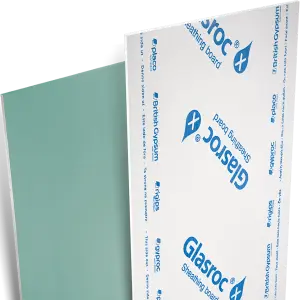
Rigips impregnated construction boards consist of a special water-resistant gypsum core encased in cardboard. This cardboard is easily recognizable by its greenish color. The boards feature delayed water absorption, comply with type GKBI according to DIN 18180 or type H2 according to DIN EN 520, and are primarily used in damp rooms in residential areas and rooms with similar requirements. Rigips impregnated construction boards are non-combustible and comply with building material class A2-s1, d0 according to DIN EN 13501-1. In addition to the impregnated construction board quality, an impregnated variant as a fire protection board is also available.
Rigips Construction Board RBI - the impregnated standard
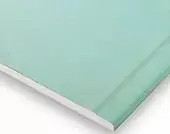
The Rigips Construction Board RBI 12.5 impregnated is a cardboard-encased gypsum board according to DIN EN 520, type H2.
It is core-impregnated, features delayed water absorption, a fiber-reinforced gypsum core, and a closed surface.
Rigips Habito - the impregnated all-rounder
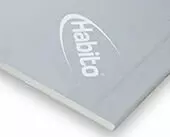
The Rigips Habito 12.5 impregnated is a cardboard-encased, solid drywall board according to DIN EN 520, type DFH2IR. It is core-impregnated, with a fiber-reinforced and solidified gypsum core and a closed surface. It is particularly robust due to its increased surface hardness against mechanical stress, and its convenient load fastening without dowels and drills is a standout feature.
Rigips Glasroc X – the specialist plasterboard
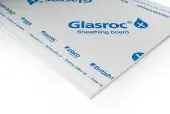
The Rigips Glasroc X is a specialised glass-fibre-reinforced plasterboard that offers exceptional resistance to moisture and mould. It features a UV-resistant glass fibre mesh, which protects the board’s hydrophobic gypsum core from harmful influences. Glasroc X complies with type GM-FH1 in accordance with DIN EN 15283-1 and was developed specifically for use in damp and wet rooms. Rigips Glasroc X is suitable for applications with moderate to very high moisture exposure, in accordance with the specified system and test documentation.
New DIN 18534-1 – more than just cement
Our special gypsum board Rigips Glasroc X, is clearly described in the waterproofing standard DIN 18534-1 under water exposure class W2-I. The VHT certificate No. Z-655-21 also provides proof of suitability for the board, offering planning certainty to specialist tradespeople. This certificate of suitability can facilitate coordination between planning and execution for the applications described. The VHT certificate No. Z-655-21 also confirms the suitability of our special gypsum board as a waterproofing substrate in water exposure class W3-I.
This means: Rigips Glasroc X remains the alternative to cement-bonded boards!
All information on suitability up to water exposure class W3‑I



Rigips System Search & RiKS Calculation Service
How many of our high-quality plasterboards do you need for your construction project? Use our practical planning tool to calculate the exact quantity and type of material required.
Depending on the load placed on the future construction, sealing may be required. Wall surfaces not exposed to splash water generally do not need to be sealed. However, for moisture-sensitive surrounding components or installation substrates, as well as for water impact classes W2-I and W3-I, surface sealing is required, even under and behind built-in components such as showers and bathtubs. This must be planned by the planner or through other suitable measures, such as sealing tapes for bathtub connections, across trades.
The flawless bonding of sealing systems on Rigips Glasroc X has been technically tested and confirmed by several renowned construction chemistry manufacturers.
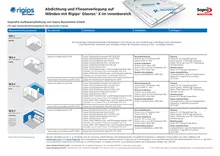
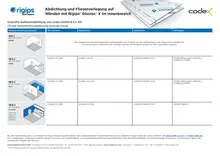
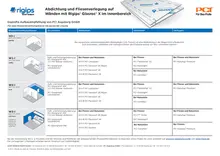
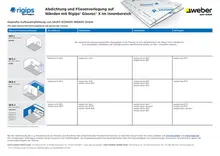
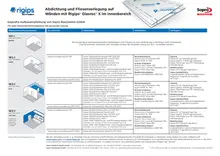
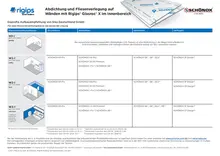
Please select the tested setup recommendation from the companies in the downloads...
Substructures made of standard profiles and accessories with a Z100 (7 μm) surface coating can be used inside buildings as long as the relative humidity generally remains below 60%, there is no condensation and no special stress is applied.
However, in damp and wet rooms, these conditions are often not met. For this reason, profiles and accessories with higher-quality corrosion protection coatings should be used.
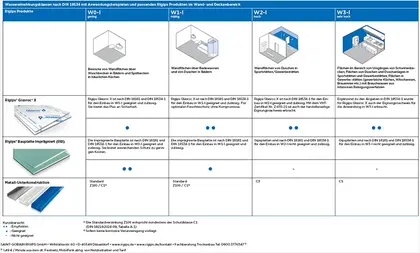
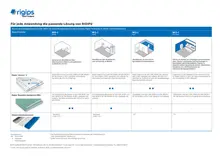
An overview of the solutions we offer can be found in the table:
The right solution from RIGIPS for every water exposure class