

Videos
Suspended and directly fixed ceilings
Ceiling systems in drywall construction with RIGIPS
Safety and aesthetic options offered by ceilings
For many people, ceilings are still just the surfaces in a room that are the most difficult to paint and where lighting is installed. However, architects, contractors and modern builders now have a very different definition of ceilings: they see them as surfaces that can be planned to offer excellent possibilities for individual room design. They also see them as aesthetically designed eye-catchers in every space and as high-tech constructions that can influence room acoustics and facilitate the hidden installation of complex lighting, sound, ventilation and cooling systems. Suspended ceilings are therefore ideal for concealing unfinished ceilings and installations.
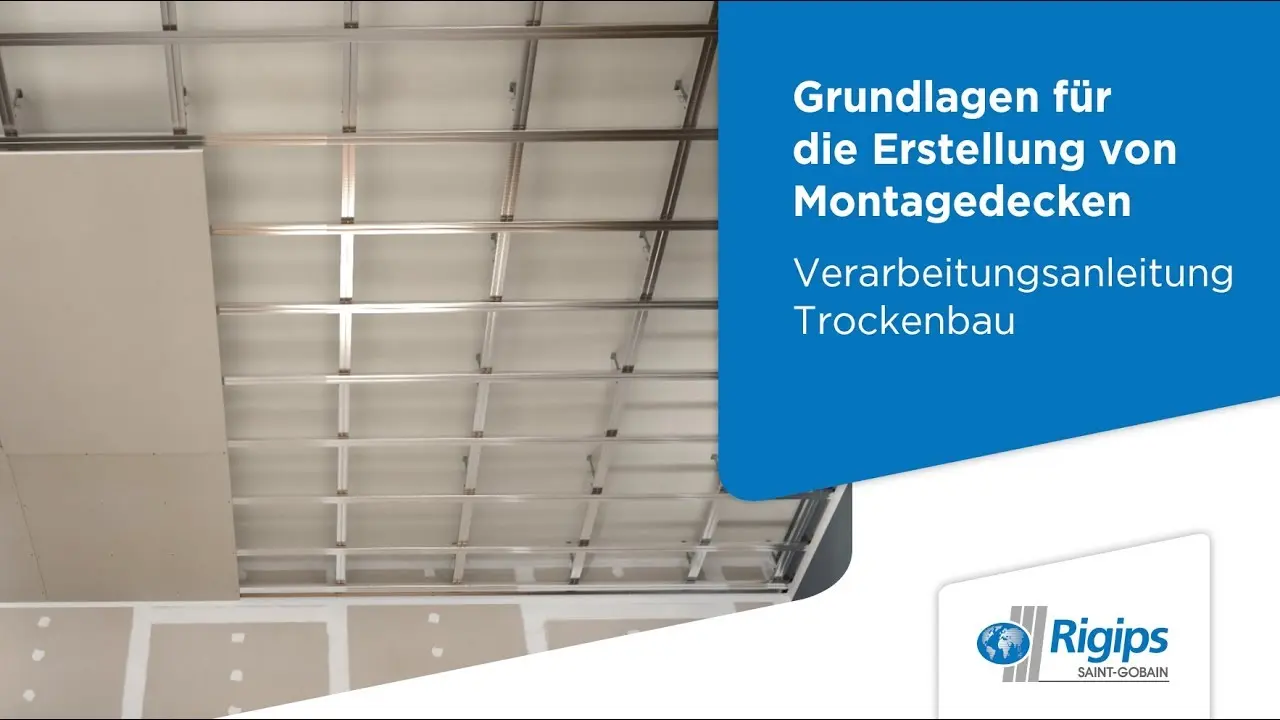
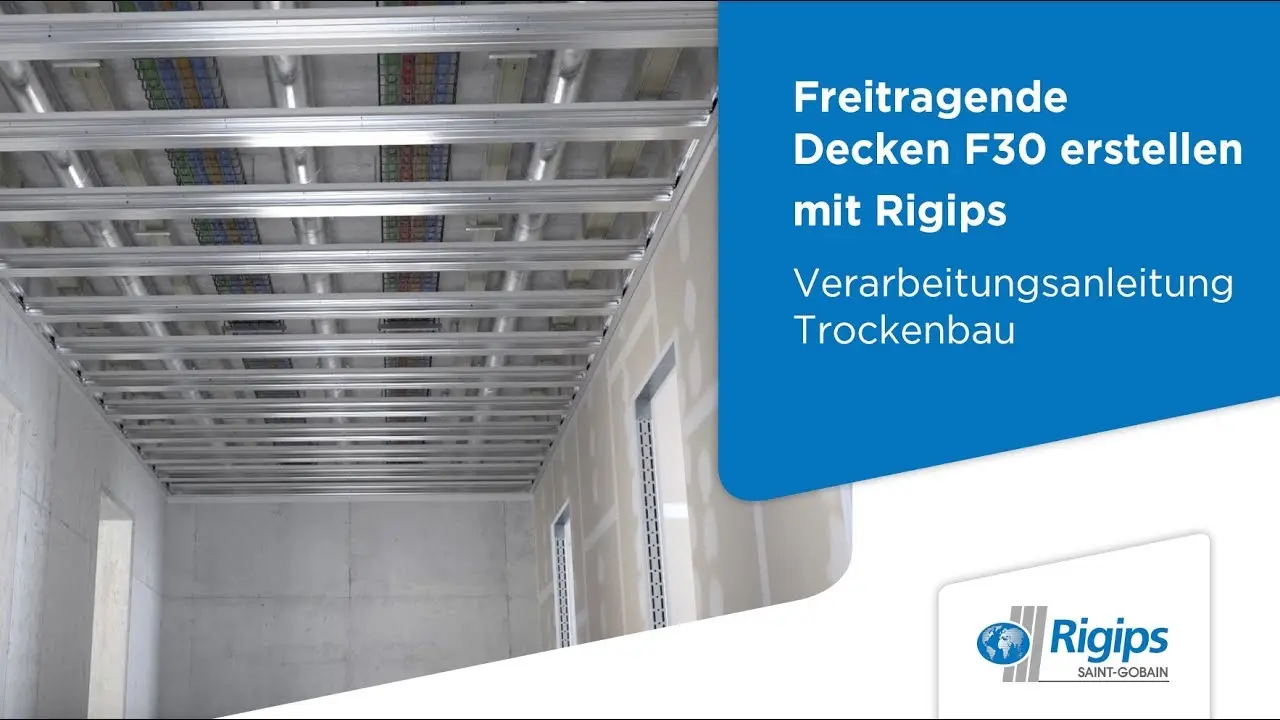
There are basically two types of drywall ceiling: suspended and directly fixed. Both construction methods allow for improved thermal insulation, saving valuable heating energy and reducing costs. At the same time, the insulation against footsteps can be improved, and depending on the construction, structural fire protection can be achieved or enhanced, for example, with wooden ceilings.
Suspended ceiling
Rigips ceilings with suspended metal substructures are ideal for reducing room height or concealing installations in the ceiling cavity. Further improvements in sound or thermal insulation can be achieved by combining them with insulating materials. Suspended ceilings are constructed using anchor quick-hangers in combination with loop wire. These are suitable for suspended ceilings under wooden or solid beam ceilings. Loop wires are available in lengths ranging from 12.5 cm to a maximum of 200 cm. Larger lengths can be supplied by Rigips upon request. The maximum load capacity per hanger is 25 kilograms.
Directly fixed ceilings
Rigips ceiling coverings with substructures that are mounted directly onto an unfinished ceiling essentially serve as a flat, paintable or wallpaperable room closure. RIGIPS particularly recommends this option for renovating damaged unfinished ceilings. Directly attached ceilings enable large, seamless coverings and, due to their low suspension height of 0–12.5 cm, are particularly advantageous in rooms with limited height. This type of ceiling is installed using direct hangers on the unfinished ceiling. By lowering the room height and incorporating insulating materials, enhanced thermal insulation can be achieved.
To the Rigips ceiling systems in 'Planning & Building'...
Integration of lighting systems, suspended lighting boards and free forms
Lighting is a fundamental tool in interior design, directly influencing comfort and the atmosphere of a room. Without the right lighting, a space cannot fully express or enhance its character. As well as daylight, sophisticated, focused lighting sources can be installed to create design accents. Suspended ceilings, for example, offer "do-it-yourselfers" a high level of creative freedom when it comes to integrating different lighting systems. Clever lighting borders and hidden fixtures can be used to create unique and atmospheric lighting effects. Standard halogen spotlights or other built-in lamps can easily be integrated into ceilings. This allows you to explore all possibilities, from creating a starry sky at home to using colour-changing LEDs.
A partially suspended ceiling allows installations to be made under a solid ceiling. For example, downlights can be installed or the cables of pendant lights can be concealed. Another way to design or enhance ceilings individually is with curved Rigips ceiling profiles, which can be used to create rounded room edges and vaulted ceilings.