

RiDuce – CO₂‑reduced system profiles from RIGIPS
Planning in a climate‑friendly way for greater sustainability in drywall construction
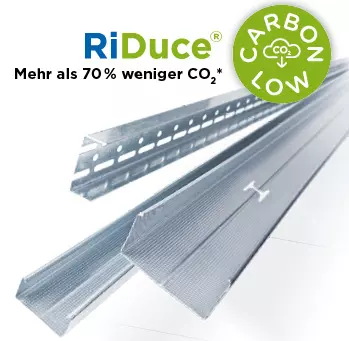
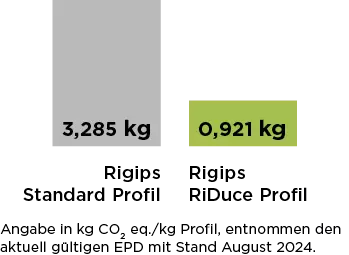
Our new RiDuce brand profile range can improve the CO₂ balance of Rigips drywall systems. RiDuce metal profiles are made from CO₂-reduced steel, resulting in a CO₂ footprint* reduced by more than 70%. This is achieved through the use of 100% renewable energy sources and the incorporation of a high proportion of 75% recycled scrap metal**.
The RiDuce system profiles can be used in all Rigips systems and are of the same quality as those produced in the normal way.
Advantages of RiDuce profiles:
● Good for the environment thanks to a more than 70% CO2 -reduced footprint*
● Short delivery routes due to production in Germany
● Safe, fully compatible with all Rigips systems
● Available as wall and ceiling profile: RigiProfil MultiTec (CW, UW, CD, UD)
● In accordance with DIN EN 14195 and DIN 18181-1
● Material type: galvanised steel sheet with MultiTec structure
● Protective coating at least 100 g/m2 on both sides (Z 100)
● Building material class A1 – non-combustible
RiDuce profiles – instantly recognisable at first glance:
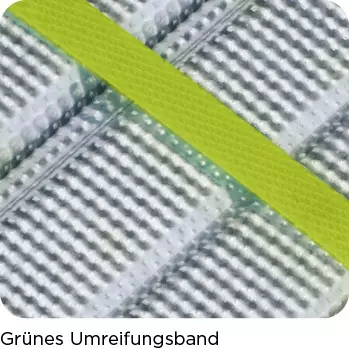
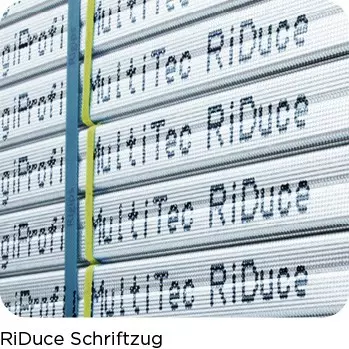
RiDuce – the new profile for optimised CO2 balance in construction
An important contribution to resource conservation and climate protection is made by offering products and systems with an optimised CO2 balance. Metal drywall profiles, a product group that is central to the creation of drywall systems, combines many advantages:
● Stable constructions / high structural reliability
● Building material class A1 - Ideal performance in the event of fire
● Resistant to moisture and climatic influences
● High contribution to the physical performance of the systems
● Easy installation and handling
● High availability
● Nearly 100% recyclability
However, steel production for the manufacturing of these almost indispensable drywall profiles is associated with significant CO2 emissions, caused by a chemical process in the blast furnace. For every ton of crude steel, about 1.7 tons of CO2 emissions are produced.
Decarbonization and modern processes:
● To reduce CO2 emissions, modern processes use non-fossil energy sources with 100% renewable electricity supply and a guarantee of origin.
● The use of scrap metal also helps to reduce CO2 emissions.
● These methods are part of decarbonization efforts and enable the production of more environmentally friendly steel.
Comparison of CO2 emissions in the production of Rigips drywall profiles (GWP-total A1-A3)
Challenges and costs
While these methods are more climate-friendly, they are more expensive to produce due to the greater effort and specialised energy sources required.
Overview of RiDuce system profile range
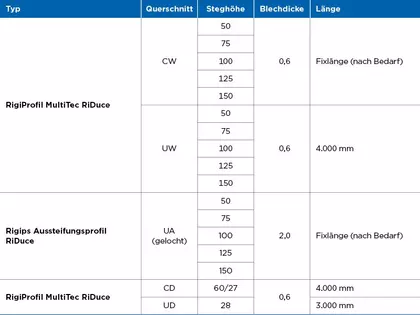
RiDuce profiles are not available from stock but are produced to order (LS 3).
Additional benefit from fixed lengths
Thanks to RIGIPS' special service, you can order fixed lengths for lightweight partition walls in the exact size you need. This ensures that the perfect profile is always delivered.
The advantages are clear: no waste, less effort and no disposal required!
Taking responsibility for tomorrow together with RIGIPS and Saint-Gobain.
Sustainable construction is a shared challenge for everyone involved – and rightly so. If we are to achieve ambitious climate goals and ensure a sustainable future, we urgently need new ways of building. To enable these approaches, suitable building systems and user-friendly planning support are needed.
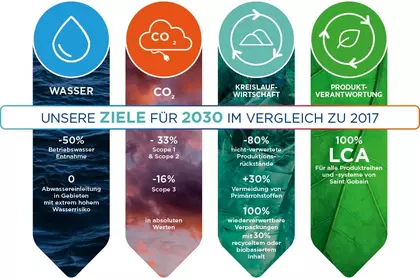
Saint-Gobain has set itself the goal of becoming climate-neutral by 2050, while also aiming to provide its customers and partners with innovative system solutions for more resource-efficient and CO2-reduced construction.
Recycling of metal profiles
Metal products can be easily dismantled and recycled into new products without any loss of quality. This conserves valuable, increasingly scarce raw materials and reduces the overall energy consumption involved in producing new items.
Rigips profiles can be easily dismantled from existing buildings and recycled through established circular routes after being collected separately by material. This makes them a valuable resource!
EASY ECO – an initiative by RIGIPS and ISOVER
Take advantage of EASY ECO, a joint initiative by RIGIPS and ISOVER. Our simple, sustainable solution helps you to reuse products and avoid waste on site. Homogeneous, clean and dry Rigips gypsum plasterboards and Rigidur gypsum fibre boards, as well as Isover mineral wool offcuts bearing the RAL quality mark, can be collected, carefully processed and fed back into the production process or recycled.
More information at: easy-eco.org
* Compared to a profile made from conventional steel sheet, produced in the same way at the same production site.
** Certified by the manufacturer’s certificate for the steel sheet.