

Gypsum – from raw material to valuable resource
Modern drywall systems from RIGIPS – producing contemporary and sustainable
Unlike any other construction method, modern drywall construction is perfectly suited to the "building of tomorrow" and all its challenges. RIGIPS' flexible, cost-effective and environmentally friendly drywall systems create living, working and leisure spaces that meet the highest standards, whether in private residences or commercial and public buildings.
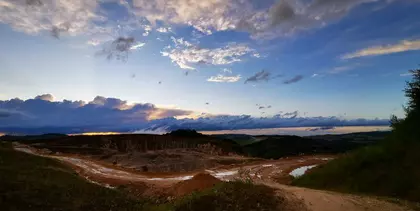
Natural gypsum - a building material with a future!
The foundation of this is gypsum, a proven building material with a history stretching back thousands of years. RIGIPS uses three resources to obtain this valuable, high-quality raw material:
- Gypsum is sourced from natural deposits, such as those found in southern Lower Saxony, northern Hesse and parts of Franconia and Baden-Württemberg.
- FGD gypsum is produced as a by-product of flue gas desulfurisation in coal-fired power stations.
- Recycled gypsum, which RIGIPS reprocesses at its production site in Gelsenkirchen-Scholven and reintroduces into the production process.
These three pillars ensure the development and use of high-performance gypsum plasterboards and fibreboards, as well as various speciality boards with specific properties, such as fire, sound or moisture protection.
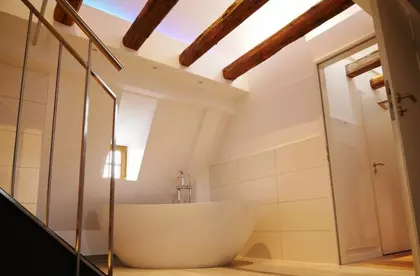
Drywall project: Senior Living Wildburg, Vallendar - Winner in the Residential Construction category at the 13th Rigips Trophy
In recent years, the processing of recycled gypsum has continuously improved, increasing its share of the production volume. Depending on the type of board, up to 40 per cent of the gypsum used is now recycled. Through its "EASY ECO" program, RIGIPS is continuing down this path and establishing itself as a pioneer in closing material cycles.
FGD gypsum is dwindling
When securing raw material supplies, all three sources of gypsum must be considered. However, a growing problem is emerging with FGD gypsum. Due to the planned phase-out of coal-fired power generation by 2038 (or potentially as early as 2030), the availability of FGD gypsum is steadily decreasing. A comprehensive study commissioned by the Federal Ministry for Economic Affairs and Climate Action has confirmed that this will lead to a supply gap in the near future.
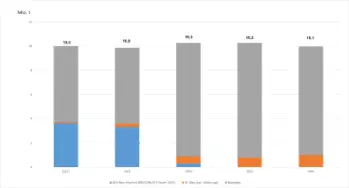
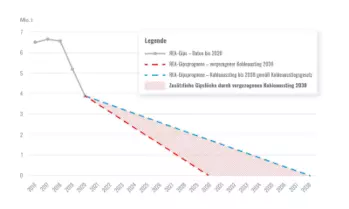
Gypsum raw material mix in Germany 2020-2024 and the expected supply gap in different scenarios. Source: BV Gypsum Industry
Since the pure recycling of demolition materials will eventually reach its natural limits, the gap in the supply of this raw material must necessarily be closed by increasing the extraction of natural gypsum deposits. Otherwise, the ambitious goal of building an additional 400,000 new apartments per year in the residential sector would hardly be achievable.
Sustainable, environmentally friendly development of high-quality extraction sites
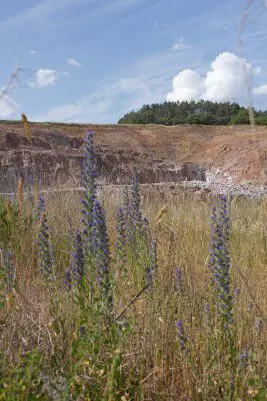
The subsequent renaturation of existing and new natural gypsum extraction sites is equally as important as their most nature-conserving use. In recent years, RIGIPS and its sister company Saint-Gobain Formula have built up considerable expertise in this area. Various research projects are studying the possibilities and opportunities arising from the renaturation and development of former extraction sites. For instance, during the summer of 2023, a team of scientists from the University of Bayreuth examined gypsum quarries across Germany (to the interviews...) to determine the impact of gypsum extraction on local plant life. The results were impressive: in post-extraction landscapes, nearly twice as many plant species were found as in adjacent areas. Quarry sites that were renatured — meaning they were not actively replanted, but left to develop naturally — were particularly species-rich and provided habitats for many endangered plant species.
Studies show that professional renaturation can utilise the "habitat potential" optimally. This increases structural, biotope and species diversity. In short, animal species that are already threatened with extinction elsewhere, such as the midwife toad, can thrive in renatured extraction sites.
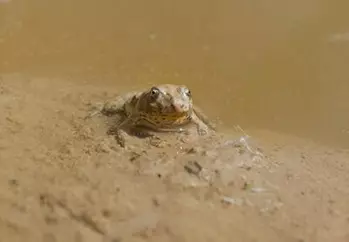
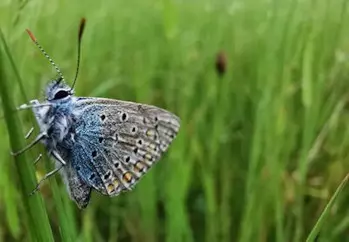
From blue butterflies to yellow-bellied toads: detailed monitoring of the flora and fauna in active and former extraction sites is essential for developing sustainable renaturation concepts. Photos: SAINT-GOBAIN RIGIPS GmbH
The renaturation of quarries offers numerous opportunities to create new and unique biotopes. Allowing natural succession — the development of characteristic communities without human intervention driven by economic purposes — enables quarries to become small biodiversity hotspots. These areas then become refuges for specialised and endangered species.
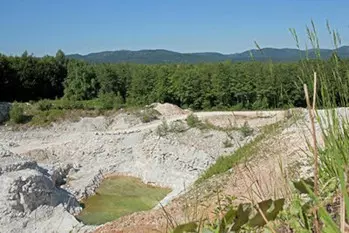
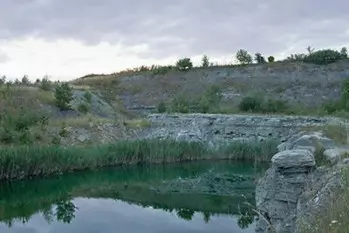
From the extraction site to the biotope, the renaturation of gypsum quarries provides a wealth of opportunities to establish new and distinctive habitats for flora and fauna. Photos: SAINT-GOBAIN RIGIPS GmbH
With animal support – species protection in quarries
In order to best support nature in creating these unique habitats and biotopes, RIGIPS employs various measures, including the use of a real "super nose" to assist with animal detection!
The idea is quite logical. If a nose can detect hidden truffles in the forest or dangerous substances at airport security, it must have sensitive sensors. This sensitivity can also be put to good use in nature conservation. Accordingly, more and more species detection and conservation dogs have been trained in recent years. These dogs can detect harmful beetle pests early on, for example, and ensure that appropriate forest quarantine measures are initiated. They can also actively contribute to the protection of endangered species and the re-establishment of animal populations.
One such task will soon be taken on by "Heliix" – Nova Scotia Duck Tolling Retriever who is currently being trained as a species detection dog©. Once fully trained, Heliix will work alongside biologists to monitor flora and fauna at extraction and renaturation sites used by RIGIPS. Specifically, Heliix will be able to assist in locating and verifying the presence of re-established sand lizards and certain amphibians, such as midwife toads and yellow-bellied toads.
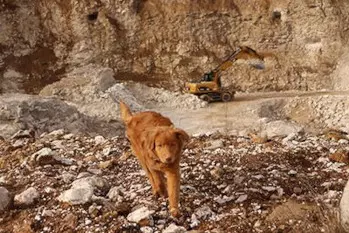
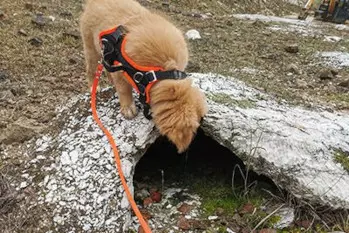
The slightly unusual trainee at RIGIPS: Heliix, a Retriever, is currently undergoing training to become Germany's first species detection and biodiversity dog specialising in "quarries". Photo (left): Saint-Gobain Formula GmbH, Photo (right): SAINT-GOBAIN RIGIPS GmbH
Once she has completed her training, Heliix's skills will be fundamental to research projects such as the GiBBS project at the Berlin Institute for Ecological Economy Research (IÖW). This project investigates how the habitat potential of extraction sites can be utilised more effectively through systematic biodiversity management. Measures to protect species during active extraction and post-use conservation play a crucial role here. To evaluate the effectiveness of these measures, appropriate monitoring is essential. As there are various methods of detecting amphibians in nature conservation, the current IÖW research project is also examining which methods are quick and easy to implement while yielding good results. In the future, professional detection dogs like Heliix could enhance the quality and efficiency of such investigations.