


Gypsum fibreboards with indoor air-purifying properties
Rigidur H Activ'Air
Drywall boards lined with Rigidur H Activ’Air gypsum fibreboards boast a variety of unique properties and benefits. Notably, robustness, air purification and surface quality play an outstanding role. Builders and users alike benefit from the walls' properties and advantages — they are actively air-purifying, smooth, hard and extremely robust. The reasons for these properties and tips for coating the boards are described below.

Production process of the Rigidur H gypsum fibreboard
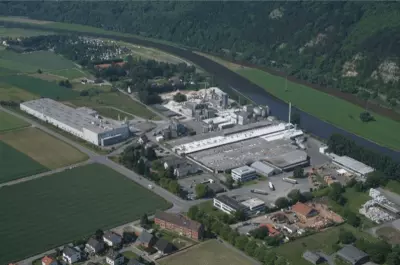
Gypsum fibreboards are made from gypsum and recycled paper fibres. Rigidur H is no exception. Its uniqueness lies in the production process: in a continuous process, the material is pressed repeatedly on a rolling line in the factory. This creates a board with a precisely defined thickness, similar to that produced by a steel rolling mill. This production process results in a hard, smooth surface. Any surface damage caused by subsequent planing of the boards is eliminated. Grinding marks and protruding fibres cannot be found on the closed surface. This manufacturing technology produces an ideal surface for all decorative final coatings.
Photo: The Rigidur gypsum fibreboard factory in Bodenwerder
Rigidur H Activ’Air - board with special air-purifying effect...
How does Activ’Air work?
Rigips' Rigidur H Activ’Air gypsum fibreboards are equipped with a special reactive agent that can absorb formaldehyde from the air inside buildings, convert this pollutant into harmless, inactive compounds and bind them permanently. This ensures the formaldehyde is degraded sustainably without the risk of being emitted again.
Many sources of pollutant emissions are within your own four walls:
The dream of owning your own home often involves purchasing an older property. This is a sustainable and cost-efficient option. However, in older prefabricated houses built using timber frame construction, materials used in the walls, floors and ceilings may emit pollutants. Rigidur H Activ’Air eliminates air pollutants before a complete renovation involving the dismantling of significant parts of the house becomes necessary.
Illustration: Diagram of the air-purifying effect
Proven effectiveness
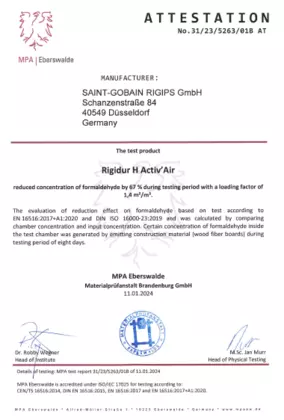
With Activ’Air technology, you can rely on proven performance. In a test conducted in accordance with ISO 16000-23, it was proven that when Activ’Air boards are installed, formaldehyde is removed from the air in the test chamber by 67% immediately and permanently. This makes a significant contribution to healthy buildings and increased comfort for those who live and work in them, which has a positive impact on human well-being in the long term. The test also shows that there is no risk of the pollutant being re-emitted from the Rigidur Activ’Air board. Current measurements on long-term effectiveness are being conducted. We estimate that Activ’Air boards will remain effective for 50 years.
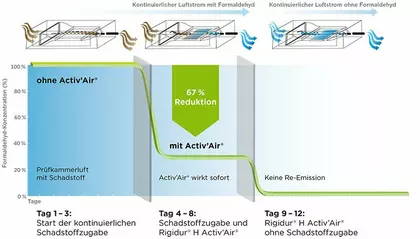
Illustration: Diagram of the test for the effectiveness of Rigidur H Activ'Air
What distinguishes the chosen test according to ISO 16000-23 from other tests...
There are many ways to measure pollutants in indoor air. An important distinction is whether a spot measurement is taken, which only measures the reduction of a specific pollutant concentration over time, or a continuous measurement is taken, which measures the reduction of pollutants in indoor air during continuous pollutant addition.
In tests conducted by testing institutes using spot measurement, the percentage reduction of air pollutants such as formaldehyde in various products is stated as 99%. While this measurement result is correct, it only shows the reduction in pollutant concentration achieved by adding a single sample of the product to a test room over a longer period.
We consider the test to be significantly more meaningful when it is standardised according to ISO 16000-23, with the pollutant formaldehyde being added continuously. This is because, in reality, continuous emissions can also be expected from sources such as furniture, floor coverings, paints and materials used in the past.
Official certificate for the air-purifying effect of Rigidur H Activ’Air gypsum fiberboards, issued by the Brandenburg Material Testing Institute
How are surface coatings applied to walls and ceilings with Rigidur H Activ’Air, and what is unsuitable?
The contractor responsible for applying the final surface coating is also responsible for inspecting the substrate and using appropriate materials. It is therefore advisable to provide the painting contractor with these guidelines in advance.
Pre-treatment of the installed wall and ceiling surface:
Any mortar splashes or spatula ridges must be removed from the board surface. All board surfaces, joints and spatula areas must be completely dry and free from dust. Joints should be smoothed according to the requirements of the subsequent coating.
Paints
All commercially available dispersion paints are suitable for painting. Other coatings, such as alkyd resin, polymer resin, polyurethane and epoxy resin paints, are also possible. For lacquers in particular, double lining and the application of Rigidur mesh tape are required (see the Thin Plaster section).
However, depending on the chosen coating, the air-purifying effect may be prevented to a greater or lesser extent by the exchange of air pollutants with the active agent in the board (e.g. with polyurethane paints or lacquers). Silicate paints, dispersion-modified silicate paints (organosilicate paints and dispersion silicate paints), and mineral-based paints, such as lime or water glass paints, are not suitable. It is advisable to apply a test coat over several board widths, including the joint areas. To reliably prevent any colour bleed-through (yellowing), a diffusion-open blocking primer should be applied.
Wallpapers
All standard types of wallpaper can be installed using commercially available wallpaper paste. Manufacturer instructions must be followed. Only adhesives based on methylcellulose and/or suitable synthetic resins should be used.
The reaction of air pollutants with the active agent in the board is reduced to a greater or lesser extent by dense surfaces, such as metal foil or vinyl wallpapers.
Tiles
Ceramic tiles (DIN EN 14411), stoneware tiles and glass mosaics can easily be applied to Rigidur gypsum fibreboards. However, these materials are not suitable for air purification, as the dense surface prevents air pollutants from reacting with the active agent in the board.
Plasters
Structural thin plasters, which are suitable for gypsum boards with a mineral or plastic base, can easily be applied to Rigips boards after a diffusion-open blocking primer has been applied. Surface fillers, however, must be applied directly to the board surface without prior priming.
For thin plasters (including clay plasters), it is necessary to apply Rigidur mesh tape (70 mm wide) to the joints to reduce stress cracks caused by building movements. The tape is extremely thin, like a fleece fabric, and does not add thickness to the joint area, yet it is highly stable. It is applied to the finished joint using Rigips VARIO joint filler or Rigips ProMix Finish. Alternatively, it can be glued to a finished, primed joint using Rigidur Nature Line joint adhesive or white glue.
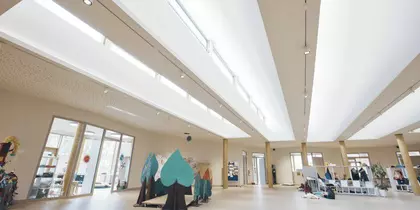
Object photos: Peter Gläsel School, Detmold