
Youth Hostel Munich-City
Drywall with flair and utmost precision
" This is where the music plays" is the motto of the Munich-City Youth Hostel's modernised, future-oriented new building extension. Indeed, this popular hostel in the heart of Munich has a strong musical focus. Like all Bavarian youth hostels, Germany's oldest city youth hostel has a thematic focus on music and dance. This makes it a popular destination for choirs, bands and dancers from across the country and beyond. The dynamic interior design of the new building was carried out by Jaeger Ausbau GmbH + Co KG. Highlights include the large, curved plasterboard ceiling construction along the main façade, as well as the similarly curved wall cladding, which spans two floors in some areas, seamlessly transitioning horizontally into the suspended ceiling constructions. All surfaces, edges and curves boast top-quality finishes to the highest Q4 standard, ensuring form and quality are in perfect harmony. In recognition of their exceptional work, the Munich-based construction professionals were presented with the newly introduced Special Prize for Surfaces at the 13th Rigips Trophy.
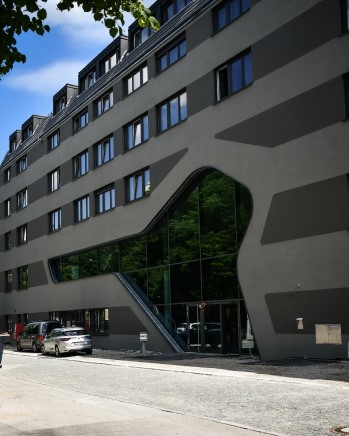
For almost 100 years, the youth hostel in the heart of Munich has been a popular destination for people of all ages and nationalities. In order to prepare Germany's oldest city youth hostel for the future, the listed old building was extensively modernised, and an extension featuring a new building combining innovative design with sustainable, resource-saving solutions was added. Photo: Rodeostudio Photography, Unterbachern
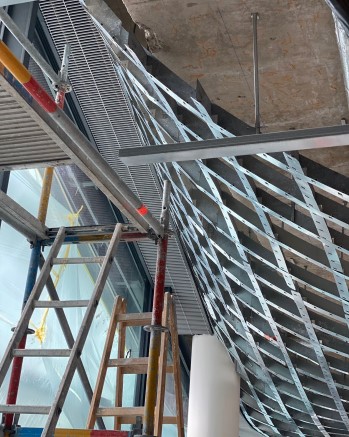
According to the plans of the GRAFT architectural firm, large, three-dimensional, curved, organic shapes made of plasterboard were installed on the ceilings and walls of the exterior and courtyard facades. The substructure consists of a three-dimensional metal beam construction, which was laser-cut using a CNC machine and is made up of numerous individual parts. Photo: Jaeger Ausbau GmbH + Co. KG, Munich.
For nearly 100 years, the youth hostel in the lively Neuhausen district has been a popular destination for people of all ages and from various nations. It is just a ten-minute subway ride from Munich's main train station. To prepare Germany's oldest city youth hostel for the future, extensive modernisation of the listed old building was carried out, along with an extension featuring a new building that combines innovative design with sustainable, resource-saving solutions. Today, the youth hostel offers approximately 400 beds spread across around 100 rooms with showers/WC and two dormitories, each with eleven beds.
Construction time shortened and optimal room acoustics thanks to perforated plasterboards
Construction of the shell for the new five-storey building, which has a gross floor area of approximately 7,430 m², began in June 2019. Completion was originally planned for May 2021. "The timeline was delayed by about a year," explains Michael Lehner, site manager at Jaeger Ausbau GmbH + Co. KG in Munich. "The main reasons were the numerous coordination efforts required between the client, architect and executing companies. Additionally, the very limited logistics space due to the city centre location posed challenges. To shorten the construction process, we used Rigitone Activ’Air 12/25 Q from RIGIPS instead of the originally planned acoustic spray ceiling. With a spray ceiling, the surface is first boarded, and then plaster is applied in a second step. The perforated plasterboard, on the other hand, is ready for use as soon as the joints have been filled. This saved us a lot of time. The board also has excellent acoustic properties. Another advantage was that we could initially close the ceiling in sections only. Since the installation work in the ceiling cavity was not yet complete everywhere, we were able to proceed according to the sectional approvals for the technical building equipment. Spray ceilings, on the other hand, must be fully and immediately closed."
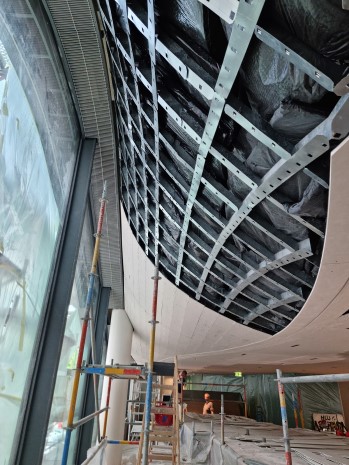
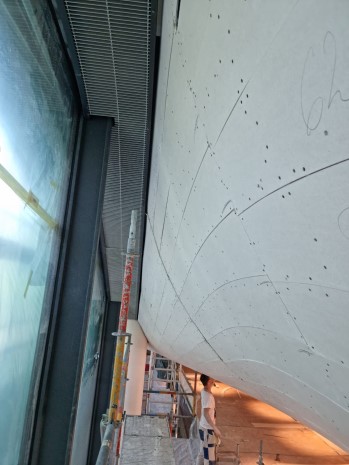
To create the boarding, Rigips GK-Form parts were cut and bent both convexly and concavely to achieve varying tight radii that transitioned smoothly into one another. Photo: Jaeger Ausbau GmbH + Co. KG, Munich.
Due to the extremely tight radii and the fact that many of the form parts were only about ten centimetres wide, the construction professionals carried out the boarding in staggered layers, using two layers of Rigips GK-Form. This concealed the curves perfectly. Additionally, the construction is more resistant to cracks. Photo: Jaeger Ausbau GmbH + Co KG, Munich.
3D-curved shapes on ceilings and walls
According to the plans of the GRAFT architectural firm, large, three-dimensional, curved, organic shapes made of plasterboard were installed on the ceilings and walls of the exterior and courtyard facades. A specialised company preproduced the 3D substructure and the extraordinary plasterboard form parts. First, the specialists for custom-made special form parts developed a 3D surface model, and then derived the technical data for the workshop and assembly plans. "The substructure is a CNC-lasered, three-dimensional metal beam construction made up of numerous individual parts that, when assembled, define the final ceiling shape," explains Armin Götzinger, Technical Project Consultant at Vogl Deckensysteme, who was responsible for this task. "For the boarding, we cut form parts from Rigips GK-Form, bending them both convexly and concavely with varying tight radii that transition smoothly into one another." The 6 mm-thick Rigips GK-Form can be bent to radii of up to 300 mm when pre-moistened and up to 600 mm when dry. As a flexible, cardboard-coated plasterboard in accordance with DIN EN 520, Type A, the board has a closed surface and is ideal for constructions that do not require fire protection.
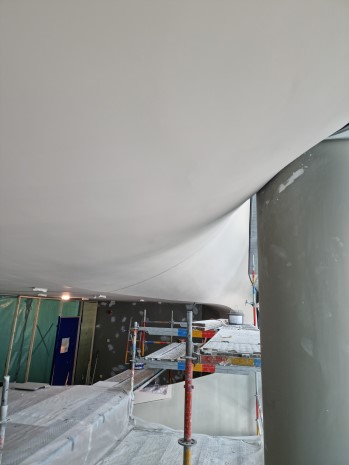
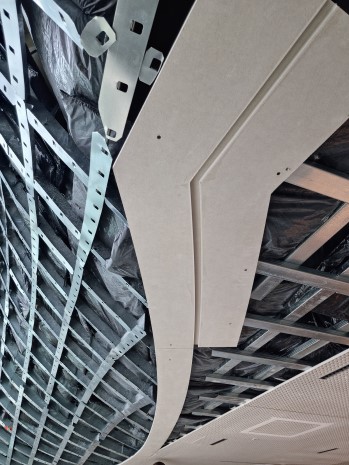
The fast and easy-to-process Rigips VARIO joint filler was initially used for the joint filling of the 3D constructions. Rigips VARIO is characterised by excellent adhesion, minimal shrinkage and high joint strength, thanks to its integrated glass fibre reinforcement strips. Due to the extreme radii of the curved constructions, the glass fabric was embedded directly into the first layer of joint filler. Construction professionals then applied the ready-to-use fine filler Rigips ProMix Finish to create the surface finish. This was applied manually in three steps. The result is top-quality surfaces that meet the Q4 standard. Photo: Jaeger Ausbau GmbH + Co. KG, Munich
After assembling the substructure for the perforated plasterboard ceiling, cavity insulation was applied. This was followed by the precise installation of the moulding that creates the transition from the horizontal ceiling to the three-dimensional construction. This required millimetre precision. Photo: Jaeger Ausbau GmbH + Co. KG, Munich
Staggered boarding with two layers of Rigips GK-Form
On-site, the numbered parts of the formwork were assembled and mounted like a large puzzle. The 3D construction elements were then attached to the ceiling using Nonius hangers. "The exact attachment points were determined using millimetre-precise 3D laser technology," explains Michael Lehner. "During production, the height coordinates were marked on each form part using a laser. The alignment of the beams, which were installed at 30 cm intervals and at varying heights, was carried out using a rotary laser." Due to their tight radii and the fact that many form parts were only about ten centimetres wide, the construction professionals carried out the boarding in staggered layers with two layers of Rigips GK-Form. "This allowed the curves to be perfectly concealed. Additionally, the construction is more resistant to cracks."
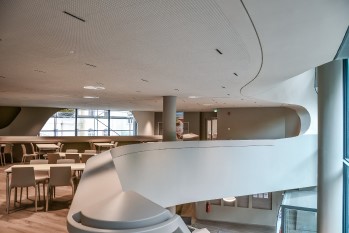
The three-dimensional curved wall construction on the courtyard façade of the building is particularly impressive, spanning two floors in some areas and transitioning seamlessly horizontally into the suspended ceiling constructions. "Like one large wave, the curved wall cladding moves according to the shape of the façade," Michael Lehner describes. "The wave rises, breaks, and then flattens out."
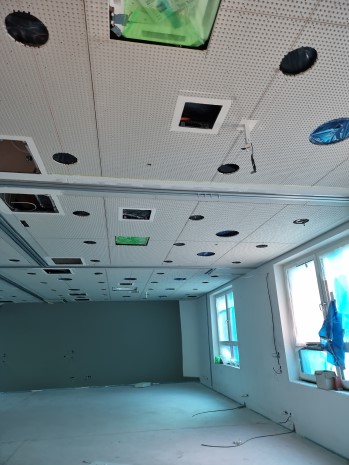
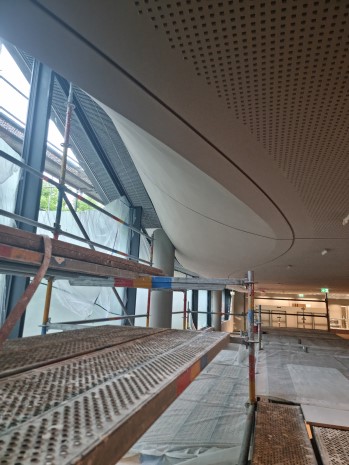
The ceiling area had a high concentration of installations, including numerous ventilation ducts and heating pipes. There were also many built-in elements and cut-outs for things like lamps and long LED light strips. Photo: Jaeger Ausbau GmbH + Co. KG, Munich.
The form parts are perfectly connected to the exterior façade. Photo: Jaeger Ausbau GmbH + Co. KG, Munich.
Millimetre-precise connection to the acoustic ceiling
The drywall professionals faced a particular challenge in the transition from the perforated horizontal plasterboard ceiling to the three-dimensional form part construction. "The form parts were, of course, intended to transition seamlessly into the suspended ceiling constructions. Therefore, the installation had to be carried out with millimetre precision. Since the curved form parts were at different distances from the raw ceiling, we also had to use different hangers at various levels for attachment."
Additionally, the ceiling featured a high density of installations, including numerous ventilation ducts and heating pipes. There were also many built-in elements and cut-outs for features such as lamps and long LED light strips, which emphasised the curved shape of the ceiling construction perfectly. "Even during the creation of the substructure, it was necessary to create all openings, access points and lamp cut-outs precisely. All shapes were first laid out on the floor to enable the profiles to be positioned accurately later on."
After assembling the substructure, cavity insulation was applied, followed by the precise installation of the respective form part to a millimetre. Rigitone Activ’Air 12/25 Q from RIGIPS was used for the boarding of the acoustic ceiling. These perforated plasterboards, which comply with DIN EN 14190, are ideal for creating high-quality wall and ceiling surfaces with special acoustic properties. "The boards are backed with laminated acoustic fleece and feature the premium 'Activ’Air' air purification effect, which is particularly valuable in spaces frequented by young people," says Michael Lehner. Thanks to the special active complex, solutions equipped with 'Activ’Air' from RIGIPS sustainably eliminate air pollutants such as formaldehyde, thus permanently improving indoor air quality.
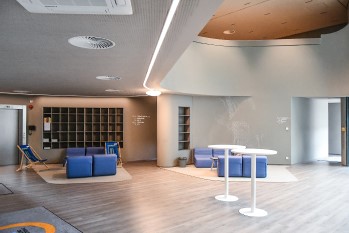
Dynamic interior design: the foyer on the ground floor – inviting and modern. Photo: Jaeger Ausbau GmbH + Co. KG, Munich.
Large, three-dimensional, curved, organic shapes are implemented perfectly. Photo: Rodeostudio Photography, Unterbachern
A four-step process for filling joints by hand
The fast and easy-to-process Rigips VARIO joint filler was initially used for the joint filling of 3D constructions made of Rigips GK-Form on ceilings and walls. Rigips VARIO is characterised by excellent adhesion, minimal shrinkage and high joint strength, thanks to its integrated glass fibre reinforcement strips. "Due to the extreme radii of the curved constructions, the glass fabric was embedded directly into the first layer of joint filler. This bridges unevenness and minimises the risk of cracks."
The surface finish was carried out by construction professionals from Munich using Rigips ProMix Finish, a ready-to-use, particularly smooth fine filler. This filler is highly white, has excellent smoothing and adhesion properties, dries quickly and is easy to sand. "The filler can be applied well with an airless machine, but this was impossible here due to space constraints," says Michael Lehner. "The rounded parts are mostly located in areas that are difficult to access. Therefore, we applied the fine filler manually in three steps."
The result is top-quality, Q4-standard surfaces on the ceilings and walls. The surfaces of the plasterboard cabinet niches and curves on the ground floor are equally high-quality, emphasising the unique spatial experience. The Rigips Trophy jury was highly impressed by the performance of the Munich-based drywall specialists. Jaeger Ausbau has created a true "jewel" in the youth hostel landscape of the Bavarian metropolis, with great dedication to detail planning and extensive expertise in surface treatment.
Construction Details:
Client: Deutsches Jugendherbergswerk Landesverband Bayern e.V., Munich
Architect: GRAFT Gesellschaft von Architekten mbH, Berlin
Drywall: Jaeger Ausbau GmbH + Co KG, Munich
Construction Management: Michael Lehner, Jaeger Ausbau GmbH + Co KG, Munich
Form Parts: Vogl Deckensysteme GmbH, Emskirchen
Rigips Regional Manager: Daniel Gatz, SAINT-GOBAIN RIGIPS GmbH
SAINT-GOBAIN RIGIPS GMBH
RIGIPS. You have the solution for everything. #RigipsForEverything
Recognised as a system provider of high-quality drywall solutions by construction professionals, RIGIPS offers a wide range of gypsum and speciality boards, Rigidur gypsum fibreboards, profiles and accessories, as well as high-performance joint fillers and compounds. The tested solutions prove their worth in interior and exterior drywall constructions. Particularly, the system offerings for weather-protected façade constructions make RIGIPS the ideal partner for timber frame construction. With its continually expanding range of healthy-living products and highly effective fire and soundproofing systems, the manufacturer stands for maximum safety and comfort. The comprehensive product and system portfolio is complemented by a wide range of services and personalised expert advice, providing valuable support in the planning and execution of even the most demanding construction projects. At the same time, RIGIPS is committed to environmental responsibility, focusing on sustainable climate protection and the conservation of natural resources. For instance, gypsum board recycling options increasingly close material cycles, while product packaging made from recycled materials reduces the need for primary raw materials. RIGIPS has repeatedly been recognised as a "Brand of the Century" and is one of the most significant brands for modern drywall solutions in the German market. The company is part of the international Saint-Gobain Group. In a nutshell: RIGIPS – building better for people and the environment.
ABOUT SAINT-GOBAIN
As a global leader in sustainable construction, Saint-Gobain develops, produces and distributes materials and services for the construction sector and industrial markets. Its integrated solutions for renovating public and private buildings, lightweight construction, and decarbonising the construction sector and industry are developed through continuous innovation. These solutions offer sustainability and performance. The Saint-Gobain Group and all its brands are driven by the shared purpose of "MAKING THE WORLD A BETTER HOME".
- €47.9 billion in revenue in 2023
- More than 160,000 employees in 76 countries
- Committed to achieving global CO2 neutrality by 2050
Find out more about Saint-Gobain at www.saint-gobain.de and follow us on
LinkedIn Saint-Gobain Germany.
Editorial contact:
baumarketing.com GmbH
Christoph Tauschwitz
Laubenweg 13
D-45149 Essen
Tel.: +49 201 2202 400
Fax: +49 201 2202 460
[email protected]