
Wildburg Senior Residence
A perfect combination of historic structure and new construction
Built in 1698 in Vallendar in the Rhineland-Palatinate region of Germany, the Wildburg complex has a turbulent history. This former noble residence has served as a cigar and cigarette factory, a reserve hospital, accommodation for war invalids, a monastery and a girls' boarding school. From August 2020 to October 2022, the building was converted and extended to create a retirement residence comprising 61 high-quality apartments. As expected, the historic sections of the building were subject to monument protection regulations, necessitating numerous special constructions, particularly with regard to fire protection. Soundproofing also played a significant role, particularly between residential units. The different parts of the building and the transition between the historic structure and the new construction prevented the development of "standard details". Instead, individually tailored solutions were repeatedly required. G+K Ausbau und Sanierung GmbH demonstrated its expertise once again in Vallendar, winning the residential construction category at the 13th Rigips Trophy 2021–23.
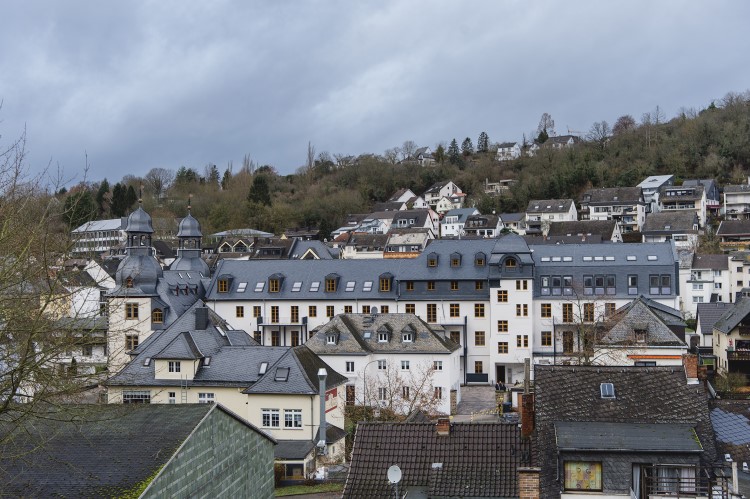
The use of Wildburg, which was built in 1698, has changed many times over the years. Today, the entire complex comprises three parts: the historic castle itself, and two annexes, one from the 19th century and one from the 20th. Photo: Saint-Gobain RIGIPS GmbH
The Wildburg senior residence comprises three full floors and an attic, offering a total usable area of around 3,800 square metres and 61 high-quality apartments. Most of these apartments are barrier-free and span up to 120 square metres. The residence is located in the heart of Vallendar, a small town in the Rhineland-Palatinate region with a population of just under 9,000. Situated six kilometres from Koblenz, Vallendar exudes the charm of bygone times with its castle and 17th- and 18th-century townhouses. At the same time, it offers all the amenities of modern life with good infrastructure and a vibrant city centre. The town and the senior residence share this defining feature, skilfully and excitingly combining old and new.
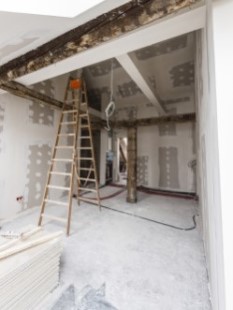
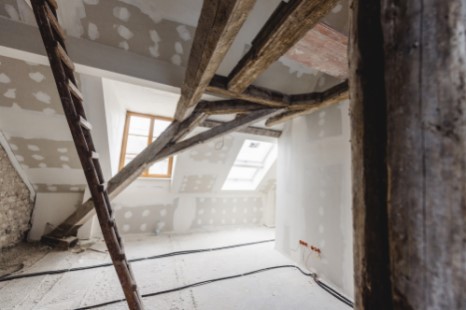 One of the most important tasks for the construction team was to preserve and reinforce the wooden structures in the historic parts of the building, both for monument protection reasons and for aesthetic purposes. Photos: © Photography Katharina Müller
A variety of systems, constructions and special solutions
"Working on centuries-old, listed buildings presents a unique challenge for all trades", says Maximilian Friedrich, Managing Director of G+K Ausbau und Sanierung GmbH, alongside Michael Koch. "In the senior residence, the challenge was further complicated by the fact that significant structural modifications could only be made during the construction process, necessitating continuous adaptation of the plans to the conditions encountered. Additionally, the building complex consists of three parts today: the historic castle and two annexes, one from the 19th century and one from the 20th century. We encountered completely different conditions building- and even floor-wise, all of which had to be reconciled." The design line and barrier-free, senior-friendly living had to be ensured, as well as monument protection for the historic sections and effective fire and soundproofing.
Accordingly, a variety of systems, constructions, and special solutions were used in Vallendar. "In particular, when it came to fire protection for the historic sections, we often had to "think outside the box" and find new solutions. Details had to be coordinated repeatedly with the client, the fire protection expert and the RIGIPS technicians. To achieve the required level of fire protection, we developed a series of special constructions using Rigips systems as a team".
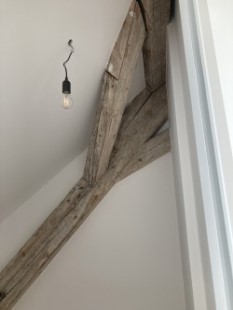
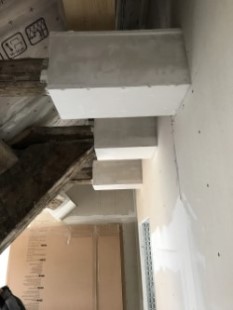
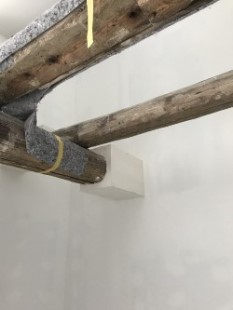
Even the wind brace in the roof of the oldest part of the building, characterised by sweeping cuts on the headbands and small surfaces, was preserved. The old roof beams were skilfully integrated into the new, independent roof structure, though they do not serve a structural function. To achieve F90 fire protection, the beams running through walls with fire protection requirements, as well as the steel supports, girders and diagonal bracing, were protected using fleece-reinforced Rigips Glasroc F.
Photos: G+K Ausbau und Sanierung GmbH, Neuwied
Preserving and reinforcing historic wooden structures
One of the most important tasks for the construction team was to preserve and reinforce the wooden structures in the historic parts of the building for both monument protection and aesthetic reasons. For example, the old truss had to be incorporated into the fire protection constructions, including the ceilings, walls, and roof slopes, in such a way as to ensure effective fire protection while meeting aesthetic requirements.
Even the wind brace in the roof of the oldest part of the building, characterised by sweeping cuts on the headbands and small surfaces, was preserved. The old roof beams were skilfully integrated into the new, independent roof structure and now serve only an aesthetic function. "To achieve F90 fire protection, we protected the beams running through walls with fire protection requirements, as well as the steel supports, girders and diagonal bracing, using Rigips Glasroc F boards in thicknesses ranging from 15 to 25 mm", explains Maximilian Friedrich. Glasroc F is a fleece-reinforced special gypsum board, as defined in DIN EN 15238-1 as type GM-FH2, with reduced water absorption and improved structural cohesion at high temperatures. This high-performance board offers the highest level of safety when planning and carrying out fire protection constructions, such as installing ducts, shaft walls, ceiling constructions and structural cladding. Even after prolonged fire exposure, Glasroc F remains stable and crack-free.
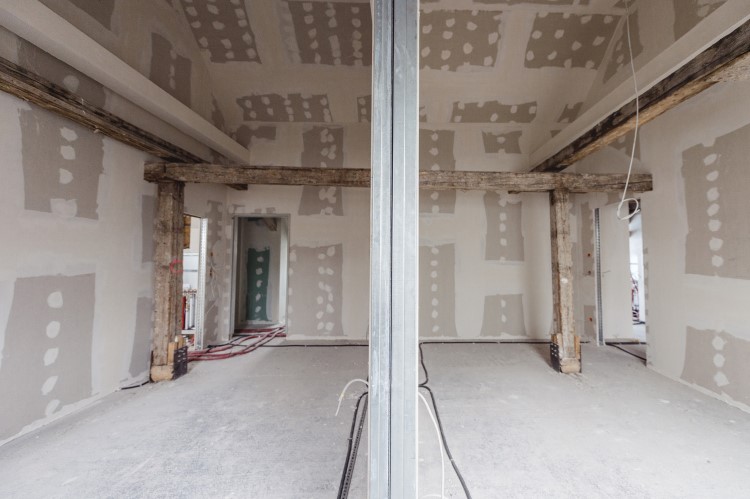
Construction professionals and Rigips technicians developed a special, complex detail for connecting the fire-resistant apartment partition walls to the roof. These walls were constructed using the MW22DH system and comprise double metal studs with 2 × 12.5 mm Rigips Die Harte boards on both sides. This special construction, planned down to the last detail, provides the walls with equally effective fire, sound and thermal protection. In accordance with the Rigips System DA31RF, a substructure of Rigips CD profiles was first erected between the rafters to reinforce the adjacent rafter fields, and this was then clad with 25 mm Rigips Die Dicke RF. The rafter fields were then insulated with ISOVER's ULTIMATE ZKF-031 fire protection inter-rafter insulation. Photo: © Photography Katharina Müller
Special construction for the roof connection of F90 partition walls
Construction professionals and RIGIPS technicians developed a complex special detail for the roof connection of the fire-resistant apartment partition walls. These were constructed as double metal stud walls with 2 × 12.5 mm Rigips Die Harte boards on both sides, using the MW22DH system. Die Harte is a paper-faced gypsum board with a dense gypsum core and a closed surface, offering high surface hardness. It is particularly robust and also offers excellent soundproofing. This special construction, which was planned down to the last detail, meets the fire, sound and thermal protection requirements of the walls equally. "To reinforce the adjacent rafter fields according to Rigips System DA31RF, we first erected a substructure of Rigips CD profiles between the rafters and then clad it with 25 mm Rigips Die Dicke RF", explains Maximilian Friedrich. Rigips Die Dicke is a paper-faced gypsum board according to DIN EN 520, type DFR, with a fibre-reinforced gypsum core and a closed surface. The board provides ideal conditions for constructing wall and ceiling systems that require fire protection and enables processing to be up to 40 per cent faster, as single-layer cladding is sufficient to achieve the necessary fire protection quality.
The rafter spaces were insulated using ISOVER's ULTIMATE ZKF-031 inter-rafter fire protection insulation. This product combines the benefits of glass wool, such as a high clamping effect, low weight and high compressibility, with the excellent fire protection of conventional stone wool (with a melting point of over 1,000°C). ULTIMATE ZKF-031 also features a line marking to make work easier and ensure pitched roofs can be insulated with minimal waste.
Construction professionals executed the flank connections of the CD profiles in the direction of the rafters using Rigips UD profiles, in accordance with the system. The cladding was fully guided around the rafters that limited the field. "To avoid a possible thermal bridge, a 15 mm distance had to be maintained between the cladding and the roof sheathing. The foil guidance continued in the same way as the rest of the roof structure, which covers an area of approximately 2,000 sqm, on the underside of the rafters. Particular attention was required for this connection detail to ensure the foil was guided wrinkle-free over the connection and the gap between the rafter cladding and the partition wall connection was minimised. This gap was tolerated as the room-side cladding of the roof slopes covered the connection strip. These slopes were constructed with fire-resistant Rigips boards".
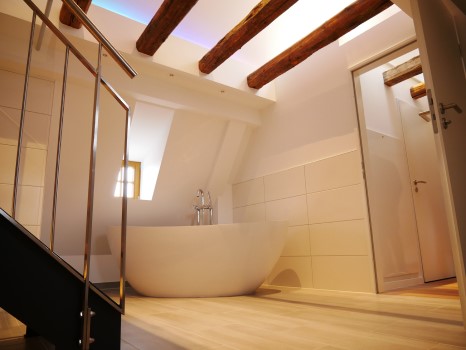
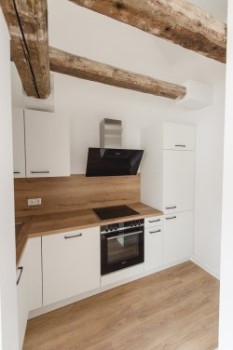
Even in functional rooms such as bathrooms and kitchens, the original roof structure had to be preserved. Fire protection wall penetrations were clad with 30–50 mm thick Rigips Glasroc F to prevent fire breakthrough. Photos: G+K Ausbau und Sanierung GmbH, Neuwied
Connection of firewalls to collar beams without fire protection quality
First, the professionals at G+K Ausbau und Sanierung GmbH clad the collar beam layer with 25 mm Rigips Die Dicke RF. "The wall connection was then made with a UA profile corresponding in width to the wall construction. The opening of the UA profile faces downward from the perspective of the collar beams," explains Maximilian Friedrich. 'After completely insulating the UA profile, we placed a UW profile over it and attached the UW profile of the wall construction to it. The connection strip is also covered by the highly fire-resistant cladding of the roof construction, in accordance with the Rigips System DA31RF. To simplify coverage of this connection, the collar beam layer was doubled using counter-battening. To secure the connection joint between the roof cladding and the partition wall, we mounted a UD profile".
Reinforcement of concrete floor slabs
The concrete floor slabs in most parts of the building were only around 10 cm thick. The required load-bearing capacity was achieved through the short spans. To meet the fire and soundproofing requirements, over 1,500 sqm of the ceiling had to be reinforced in accordance with construction type III. "According to Rigips System DB11GR, we used 15 mm-thick fleece-reinforced Rigips Glasroc F for the cladding,' explains Maximilian Friedrich. 'To improve soundproofing, the mineral wool overlay was installed in two layers using ISOVER Protect BSP 40 — a stone wool board offering A1 fire protection and good sound insulation thanks to its optimal flow resistance".
"Since the renovated ceilings were visible throughout, we used the Rigips paper reinforcement strip for the Glasroc F butt joints. This strip provides maximum joint strength and crack resistance. However, due to the precise adherence to the joint dimensions and the paper strip's moisture-induced swelling during embedding, processing was more challenging than with ordinary gypsum board ceilings. Although it was more labour-intensive, the result was perfect."
The expert jury of the 13th Rigips Trophy 2021 | 2023 was thoroughly impressed by the performance of G+K Ausbau und Sanierung GmbH and the "exemplary connection of existing and new construction." "With numerous special constructions, which were only realisable in this form with modern drywall systems, the construction professionals found convincing solutions to the fire and soundproofing challenges," was the experts' verdict.
Construction details:
Client: Victoria S.á.r.l., Luxembourg
General contractor: Acons Bauunternehmung GmbH & Co. KG, Vallendar
Architect: PQH3 Architekten, Koblenz
Drywall: G+K Ausbau und Sanierung GmbH, Neuwied
Rigips Regional Manager: Frank Ditten, SAINT-GOBAIN RIGIPS GmbH
SAINT-GOBAIN RIGIPS GMBH
RIGIPS. You have the solution for everything. #RigipsForEverything
Recognised as a system provider of high-quality drywall solutions by construction professionals, RIGIPS offers a wide range of gypsum and speciality boards, Rigidur gypsum fibreboards, profiles and accessories, as well as high-performance joint fillers and compounds. The tested solutions prove their worth in interior and exterior drywall constructions. Particularly, the system offerings for weather-protected façade constructions make RIGIPS the ideal partner for timber frame construction. With its continually expanding range of healthy-living products and highly effective fire and soundproofing systems, the manufacturer stands for maximum safety and comfort. The comprehensive product and system portfolio is complemented by a wide range of services and personalised expert advice, providing valuable support in the planning and execution of even the most demanding construction projects. At the same time, RIGIPS is committed to environmental responsibility, focusing on sustainable climate protection and the conservation of natural resources. For instance, gypsum board recycling options increasingly close material cycles, while product packaging made from recycled materials reduces the need for primary raw materials. RIGIPS has repeatedly been recognised as a "Brand of the Century" and is one of the most significant brands for modern drywall solutions in the German market. The company is part of the international Saint-Gobain Group. In a nutshell: RIGIPS – building better for people and the environment.
ABOUT SAINT-GOBAIN
As a global leader in sustainable construction, Saint-Gobain develops, produces and distributes materials and services for the construction sector and industrial markets. Its integrated solutions for renovating public and private buildings, lightweight construction, and decarbonising the construction sector and industry are developed through continuous innovation. These solutions offer sustainability and performance. The Saint-Gobain Group and all its brands are driven by the shared purpose of "MAKING THE WORLD A BETTER HOME".
- €47.9 billion in revenue in 2023
- More than 160,000 employees in 76 countries
- Committed to achieving global CO2 neutrality by 2050
Find out about Saint-Gobain at www.saint-gobain.de and follow us on
LinkedIn Saint-Gobain Germany.
Editorial Contact:
baumarketing.com GmbH
Christoph Tauschwitz
Laubenweg 13
D-45149 Essen
Tel.: +49 201 2202 400
Fax: +49 201 2202 460
[email protected]