

Timber on the hillside
Alpine flair in Saxony – Single-family house in ecological timber construction with innovative energy concept
Anyone visiting homeowner Florian Bäßler in his new residence in Plauen, Saxony, might easily get alpine "feelings." This is partly due to the property's exposed hillside location, and partly due to the construction style and materials used for the three-storey building. "I am an absolute mountain enthusiast and spend as much time as possible in the Alps. I've always been fascinated by the architecture of the chalets commonly found there — an architecture that fits perfectly with this property", says the new homeowner, who is passionate not only about mountains, but also about wood as a building material. The attractive result of this combination is a single-family home in the Alpine chalet style. Built using innovative timber construction, it features a nearly self-sufficient energy concept and a cosy atmosphere.
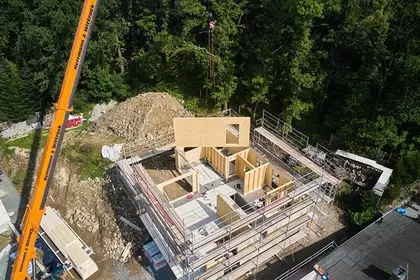
Construction work began in Plauen, Saxony, at the start of 2021. Photos: SAINT-GOBAIN ISOVER G+H AG / SAINT-GOBAIN RIGIPS GmbH
The property in Plauen offers an alpine experience, further enhanced by the nearby Pöhl Dam, a worthy substitute for a mountain lake. Despite its attractiveness, the property presented some challenges for the homeowner and executing companies. "Due to the hillside location, numerous reinforcement and safety measures were necessary. Additionally, the ground consists of solid natural rock, which made excavating the basement at the start of construction in January 2021 quite complex", explains Florian Bäßler.
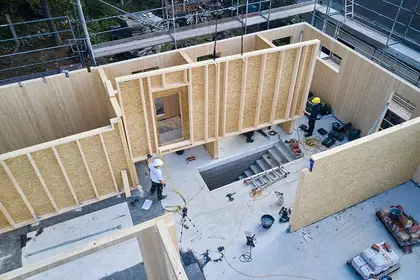
The load-bearing walls are made of 160 mm-thick cross-laminated timber and are insulated with 160 mm-thick Kontur FSP 1-032 façade insulation slabs from ISOVER.
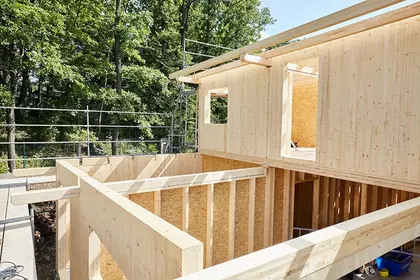
High-performance timber construction
The basement, which measures approximately 100 m², was the only part of the building constructed using solid methods. Reinforced concrete walls were erected on the poured foundation slab and insulated with 100 mm-thick Styrodur® 3035 rigid foam panels. Styrodur® is a registered trademark of BASF SE. Construction then continued entirely in timber. For the production and assembly of the exterior walls, Florian Bäßler enlisted the help of the experts at Wolf Carpentry in nearby Mylau. "In total, we built just over 200 m² of exterior walls", explains Udo Pürzel, managing director of Wolf carpentry. "The load-bearing walls are based on 160 mm-thick cross-laminated timber and a suspended, ventilated façade cladding on a wooden substructure, including 160 mm-thick insulation with Kontur FSP 1-032 façade insulation slabs from ISOVER. These fleece-coated glass wool slabs were not only easy to work with, but also crucial to the planned energy concept thanks to their low thermal conductivity of 0.032 W/(m·K)." After installing 40 mm-thick wooden battens to ensure the necessary ventilation layer, and laying a diffusion-open façade membrane across the entire surface, attractive rhombus slats made of Siberian larch were used to complete the façade cladding.
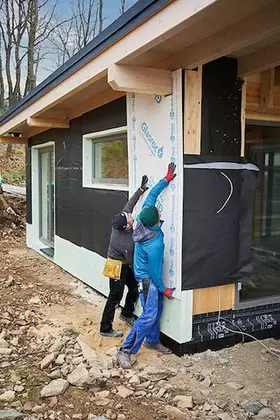
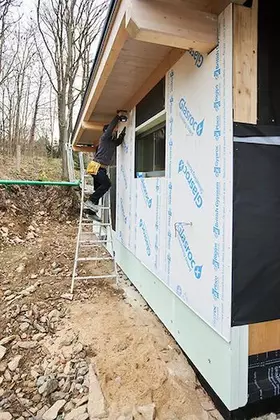
The exterior wall areas on the ground floor and the inner loggia were clad with Rigips Glasroc X, a fleece-reinforced special gypsum board from RIGIPS. This moisture-resistant board is ideal for cladding exterior walls in timber construction and has many advantages.
Drywall in the exterior with a tested solution
An exception was made for the exterior walls on the ground floor and the inner loggia. The homeowner clad these himself, looking for a quick and easy solution. He found it in the fleece-reinforced special gypsum board Glasroc X from Rigips. This moisture-resistant board is specifically designed for cladding exterior walls in timber construction and offers several advantages. "The relatively low weight of the boards made the work easier, especially since we opted for a room-high design, i.e. three-metre-high boards. Additionally, the boards could be cut like regular hard gypsum boards by simply scoring them with a standard blade knife and then breaking them cleanly. This meant there was no need for elaborate cutting with a plunge saw and guide rail, ensuring rapid progress in construction. Installation on the underlay membrane and supporting battens could be completed in just a few steps", says Florian Bäßler. Another advantage of Rigips Glasroc X is that the boards provide immediate weather protection, eliminating the need for drying times and making them almost independent of weather conditions. They can also be directly plastered. In Plauen, exterior wall work in these areas was completed by installing a reinforcement mesh, applying a textured plaster and silicone resin paint.
The homeowner also relied on the combination of wood and gypsum inside the ground and upper floors, which together offer approximately 175 m² of living space. "We deliberately wanted to use the contrast between the wood and the bright gypsum surfaces for the interior design. For the interior cladding of the exterior and partition walls, we therefore opted for three-layer spruce boards, which we combined with Rigips fire protection boards on the ground floor and room-high Rigidur H gypsum fibre boards from RIGIPS on the upper floor. The latter are characterised, among other things, by their robustness and surface hardness. Additionally, the gypsum fibre boards have extremely smooth surfaces, which allow for particularly high-quality wall surfaces with minimal filling effort," says Florian Bäßler.
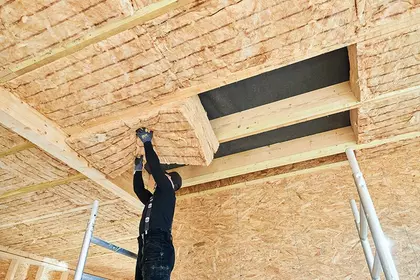
The upper part of the building has two fully ventilated shed roofs. The cavities were insulated with 240 mm-thick intermediate rafter insulation (ISOVER Integra ZKF 1-032), which is made of glass wool. A diffusion-open underlay membrane was then laid on the insulated roof and a 80 mm wide ventilation space was created using structural timber. Subsequent sheathing and a bituminous welded membrane were installed to seal the roof in preparation for the later installation of photovoltaic modules.
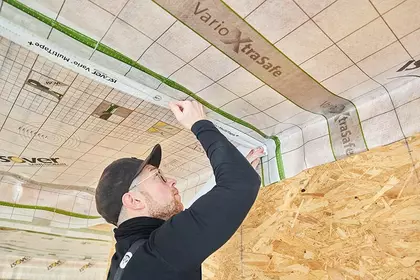
To ensure optimal performance in terms of building physics safety, the Vario® airtightness and moisture protection system from ISOVER is ideal. This includes the moisture-variable Vario® XtraSafe climate membrane (sd-value: 0.3–25 m) and perfectly matched system components, including sealants and adhesive tapes.
240 mm intermediate rafter insulation with WLS 032
Wolf Carpentry constructed the intermediate ceiling between the ground and upper floors using a 200 mm-thick solid timber construction. The upper part of the building consists of two fully ventilated shed roofs. These were fully insulated with 240 mm-thick intermediate rafter insulation (ISOVER Integra ZKF 1-032), made of glass wool, and fitted with the Vario® airtightness and moisture protection system on the interior side. This includes the moisture-variable Vario® XtraSafe climate membrane (sd-value 0.3–25 m), as well as perfectly matched system components, such as sealants and adhesive tapes. An 80 mm wide ventilation space was then ensured using structural timber, and a diffusion-open underlay membrane was laid on the insulated roof. Subsequent sheathing and a bituminous welded membrane formed the basis for the later installation of photovoltaic modules.
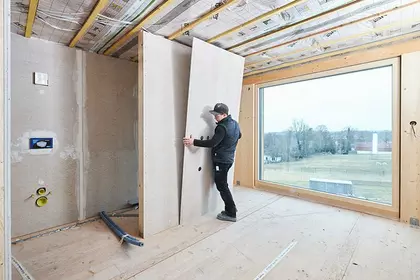
Partition walls and various installations were clad with room-high Rigidur H gypsum fibre boards.
Energetically self-sufficient and cost-effective
"Thanks to these constructions and the high-performance insulation, we achieved U-values of 0.15 W/(m²K) for the exterior walls and 0.18 W/(m²K) for the roof. The building meets KfW-55 requirements and generates all the electricity it needs. This is made possible by a large 16.5 kW peak photovoltaic system on the roof, a 15 kWh electric storage unit in the basement, a 350-litre hot water tank and an air-to-water heat pump. Combined with numerous smart home features, the house has a base load of 10–15 kWh per day in summer and 25–30 kWh per day in winter. In summer, around 80 to 100 kWh of electricity is generated daily, most of which is fed into the public power grid. The small amount of electricity we need to purchase in winter is almost entirely offset by the summer feed-in compensation", reports the proud homeowner.
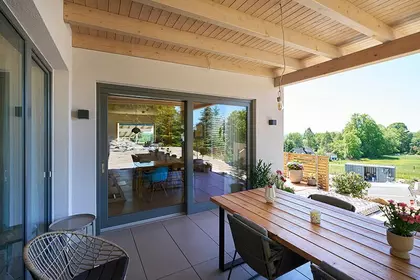
Loggia with a view.
Upon its completion at the end of 2022, a piece of alpine flair was brought to the Vogtland district in Saxony in the form of a highly modern and sustainable residential building. It impresses with its forward-looking energy concept and comfortable living conditions.
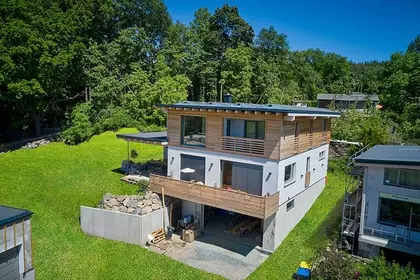
Energetically self-sufficient: The building meets KfW-55 requirements and generates all the electricity it needs on site. This is made possible by a large 16.5 kW peak photovoltaic system on the roof, a 15 kWh electric storage unit in the basement, a 350-litre hot water tank and an air-to-water heat pump. Photos: SAINT-GOBAIN ISOVER G+H AG / SAINT-GOBAIN RIGIPS GmbH
SAINT-GOBAIN RIGIPS GMBH
RIGIPS. You have the solution for everything. #RigipsForEverything
Recognised as a system provider of high-quality drywall solutions by construction professionals, RIGIPS offers a wide range of gypsum and speciality boards, Rigidur gypsum fibreboards, profiles and accessories, as well as high-performance joint fillers and compounds. The tested solutions prove their worth in interior and exterior drywall constructions. Particularly, the system offerings for weather-protected façade constructions make RIGIPS the ideal partner for timber frame construction. With its continually expanding range of healthy-living products and highly effective fire and soundproofing systems, the manufacturer stands for maximum safety and comfort. The comprehensive product and system portfolio is complemented by a wide range of services and personalised expert advice, providing valuable support in the planning and execution of even the most demanding construction projects. At the same time, RIGIPS is committed to environmental responsibility, focusing on sustainable climate protection and the conservation of natural resources. For instance, gypsum board recycling options increasingly close material cycles, while product packaging made from recycled materials reduces the need for primary raw materials. RIGIPS has repeatedly been recognised as a "Brand of the Century" and is one of the most significant brands for modern drywall solutions in the German market. The company is part of the international Saint-Gobain Group.
In a nutshell: Rigips® – for better building for the benefit of people and the environment.
ABOUT SAINT-GOBAIN
As a global leader in sustainable lightweight construction, Saint-Gobain develops, produces, and distributes materials and services for the construction sector and industrial markets. Its integrated solutions for the renovation of public and private buildings, lightweight construction, and the decarbonization of the construction sector and industry are developed through a continuous innovation process. They offer sustainability and performance. The Saint-Gobain Group and all its brands are driven by the shared purpose of "MAKING THE WORLD A BETTER HOME".
- €51.2 billion in revenue in 2022
- More than 168,000 employees, represented in 75 countries
- Committed to achieving CO2 neutrality by 2050
Find out more about Saint-Gobain at www.saint-gobain.de
and follow us on LinkedIn Saint-Gobain Germany.
Further information:
SAINT-GOBAIN RIGIPS GMBH
Schanzenstraße 84
40549 Düsseldorf
P.O. Box 11 09 48
40509 Düsseldorf
Phone: 02 11 / 55 03-0
Fax: 02 11 / 55 03-208
[email protected]
Editorial contact:
baumarketing.com GmbH
Christoph Tauschwitz
Laubenweg 13
D-45149 Essen
Tel.: +49 201 2202 400
Fax: +49 201 2202 460
[email protected]