

A nose for biodiversity
Species protection in quarries – RIGIPS trains Germany's first species detection dog specialised in investigating quarries
The continuous decrease in the amount of available flue gas desulfurisation (FGD) gypsum, a by-product of coal power generation, means that German drywall manufacturers are increasingly focusing on extracting natural gypsum as a raw material. To this end, potential mining sites, particularly in the Southern Harz, Northern Hesse, Central Franconia, Lower Franconia and Baden-Württemberg regions, are being investigated and developed. The subsequent renaturation of the quarries is equally important as their most environmentally friendly use, which is why manufacturers like RIGIPS have been researching and working on sustainable concepts for former and future mining areas for many years. Biologist and landscape scientist Annika Kruse coordinates and monitors the implementation of these concepts on-site for RIGIPS, and has recently received some animal support.
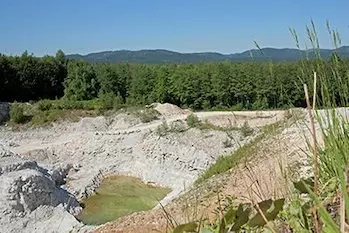
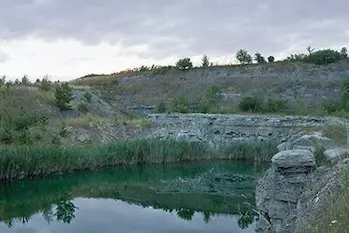
From mining site to biotope: renaturing gypsum quarries creates new and unique habitats for plants and animals, offering numerous opportunities and impulses. Photos: SAINT-GOBAIN RIGIPS GmbH
It is a logical thought in itself: a nose that can detect hidden truffles in the forest or dangerous substances at airport security must be highly sensitive. This sensitivity can and should also be utilised for nature conservation purposes. Accordingly, an increasing number of species-tracking and conservation dogs have been trained in recent years. For example, they can detect harmful beetle pests at an early stage, helping to ensure that the necessary forest quarantine measures can be initiated. They can also actively contribute to the protection of endangered species and the resettlement of animal species.
"As part of our quarrying operations, whether we're developing a new section or restoring areas that are no longer needed, it's crucial to understand the local wildlife and their populations. The human eye is only conditionally suitable for this task", explains Annika Kruse, who, together with her colleagues, oversees around 20 sites for RIGIPS and its sister company, Saint-Gobain Formula. "It's therefore not surprising that trained conservation dogs have been used in other countries for some time. But in Germany, numerous studies are now also examining the potential of these animal specialists in various areas." RIGIPS is supporting this approach by training Germany's first "quarry and species-tracking dog".
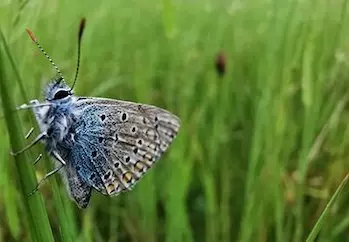
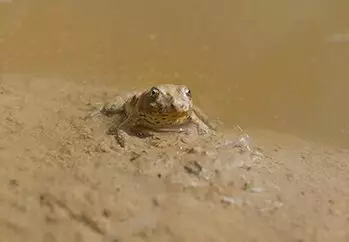
From the Common Blue butterfly to the Yellow-bellied Toad: detailed monitoring of flora and fauna in active and former mining areas is essential for developing sustainable renaturation concepts. Photos: SAINT-GOBAIN RIGIPS GmbH
Successful animal and plant monitoring
Enter "Heliix": the Nova Scotia Duck Tolling Retriever, born in September 2022, has been accompanying Annika Kruse in her quarry investigations for several months now. "This phase can be seen as basic initial training. Currently, the female dog is becoming accustomed to the regular quarry operations, including the quarry vehicles and personnel in protective gear. Most importantly, she can familiarise herself with the landscape itself, including rubble piles, small bodies of water and slopes. Afterwards, Heliix will learn how to search specifically for certain animal and plant species, helping us to complete flora and fauna monitoring in the mining and renaturation areas once her training is over."
The biologist sees great potential in searching for and detecting resettling sand lizards or specific amphibians, such as the yellow-bellied toad or the midwife toad. In addition to developing the necessary tracking skills, it is particularly important for Heliix to learn to simply stare at the animal or plant in question to indicate its presence. "Approaching with her nose or paw is, of course, out of the question. Heliix must also be able to correctly identify the animal in difficult terrain later on, despite distractions and various weather conditions. We will gradually train her for this in many small steps over the next two years."
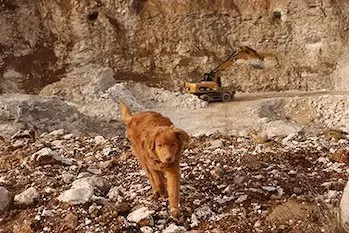
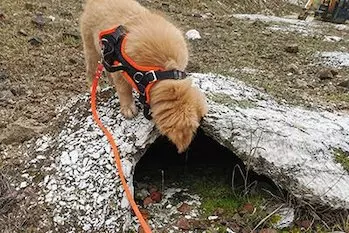
The somewhat unconventional trainee at RIGIPS: Heliix, a retriever, is currently being trained to become Germany's first biodiversity and species-tracking dog specialising in quarries. Photo (left): Saint-Gobain Formula GmbH, Photo (right): SAINT-GOBAIN RIGIPS GmbH
Supporting numerous research projects
If Heliix, the female dog, successfully completes this training, her abilities will be fundamental to research projects such as that of the Berlin Institute for Ecological Economic Research (IÖW). The aim of this project is to develop a practical biodiversity monitoring system for mining areas. Additionally, conservation specialists from the University of Bayreuth are investigating plant species diversity in quarries used by RIGIPS, among others. "The renaturation of quarries offers numerous opportunities to create new and unique biotopes. Studies show that allowing succession — that is, the natural sequence of characteristic ecosystems without human, economically driven intervention — can lead to quarries becoming small biodiversity hotspots. These areas then become refuges for specialised and endangered species", says Annika Kruse.
SAINT-GOBAIN RIGIPS GMBH
RIGIPS. You have the solution for everything. #RigipsForEverything
Recognised as a system provider of high-quality drywall solutions by construction professionals, RIGIPS offers a wide range of gypsum and speciality boards, Rigidur gypsum fibreboards, profiles and accessories, as well as high-performance joint fillers and compounds. The tested solutions prove their worth in interior and exterior drywall constructions. Particularly, the system offerings for weather-protected façade constructions make RIGIPS the ideal partner for timber frame construction. With its continually expanding range of healthy-living products and highly effective fire and soundproofing systems, the manufacturer stands for maximum safety and comfort. The comprehensive product and system portfolio is complemented by a wide range of services and personalised expert advice, providing valuable support in the planning and execution of even the most demanding construction projects. At the same time, RIGIPS is committed to environmental responsibility, focusing on sustainable climate protection and the conservation of natural resources. For instance, gypsum board recycling options increasingly close material cycles, while product packaging made from recycled materials reduces the need for primary raw materials. RIGIPS has repeatedly been recognised as a "Brand of the Century" and is one of the most significant brands for modern drywall solutions in the German market. The company is part of the international Saint-Gobain Group.
In a nutshell: Rigips® – for better building for the benefit of people and the environment.
ABOUT SAINT-GOBAIN
As a global leader in sustainable lightweight construction, Saint-Gobain develops, produces, and distributes materials and services for the construction sector and industrial markets. Its integrated solutions for the renovation of public and private buildings, lightweight construction, and the decarbonization of the construction sector and industry are developed through a continuous innovation process. They offer sustainability and performance. The Saint-Gobain Group and all its brands are driven by the shared purpose of "MAKING THE WORLD A BETTER HOME".
- €51.2 billion in revenue in 2022
- Over 168,000 employees, represented in 75 countries
- Committed to achieving CO2 neutrality by 2050
Find out more about Saint-Gobain at www.saint-gobain.de
and follow us on LinkedIn Saint-Gobain Germany.
Further Information:
SAINT-GOBAIN RIGIPS GMBH
Schanzenstraße 84
40549 Düsseldorf
PO Box 11 09 48
40509 Düsseldorf
Phone: +49 211 / 55 03-0
Fax: +49 211 / 55 03-208
[email protected]
Editorial Contact:
baumarketing.com GmbH
Christoph Tauschwitz
Laubenweg 13
D-45149 Essen
Tel.: +49 201 2202 400
Fax: +49 201 2202 460
[email protected]