

New building of the Fraunhofer Institute for Energy Economics and Energy System Technology (IEE)
Okel GmbH & Co. KG takes first place at the 13th Rigips Trophy 2021 I 2023 in the Non-Residential Construction category
Since May 2022, the Fraunhofer Institute for Energy Economics and Energy System Technology in Kassel has brought together its various locations across the city in a new building designed specifically for the needs of the research institute. The four-storey building offers approximately 7,600 square metres of usable space. The ground floor is home to a technical centre consisting of various optimised building structures unified by a surrounding roof design. Above the technical centre is a partially floating office block. The building's design aimed to optimise each structure for its intended use, resulting in diverse requirements in terms of safety, flexibility, and future adaptability. Okel GmbH & Co. KG. handled the entire technical design, detailed planning, and implementation of the project. The drywall specialists from Diemelstadt were doubly rewarded for their outstanding performance in interior construction, winning both the 13th Rigips Trophy and the silver trophy in the non-residential category at the Saint-Gobain GYPSUM International Trophy 2023 — the unofficial world championship of drywall construction.
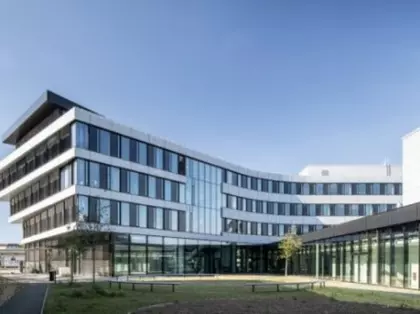
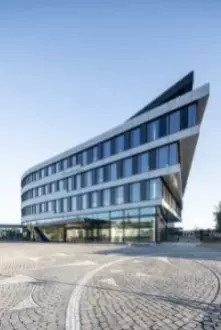
The four-storey building offers approximately 7,600 square metres of usable area. The ground floor is home to a technical centre consisting of various optimised building structures unified by a surrounding roof design. Above the technical centre is a partially floating office block. Photos: Foerderraum, Henry Koch
The impressive Fraunhofer IEE building is located directly opposite Kassel's main train station and provides workspace for around 320 people. The institute conducts research in the fields of energy economics and energy system technology. The institute develops solutions for transforming energy systems, such as reducing the cost of using renewable energy, ensuring a stable supply despite volatile generation and ensuring the economic success of the energy transition.
Four floors for research and development
Approximately two-thirds of the 7,600 square metres of usable space are dedicated to office areas, with the remaining third allocated to laboratories and technical centres. The rooms were specifically designed for their intended use, with the flexibility to adapt to future requirements. All four floors are connected via a central, light-filled atrium. Extending up to the roof, it largely serves as a space for communication and diverse collaboration with partners and clients. A striking focal point is the "Great Vertical", a "floating" wall that extends up to the roof.
In addition to the uniquely designed entrance hall, the entire ground floor is dedicated to the technical centre and a bistro. In order to accommodate diverse future requirements, the ceiling height in this area varies between four and eight metres. The laboratories have access to courtyards integrated into the building, allowing for direct deliveries. Above the technical centre is the three-storey office block, which has double and open-plan offices. The third floor houses a modern, multifunctional seminar and conference centre.
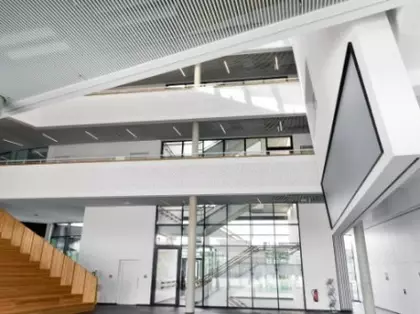
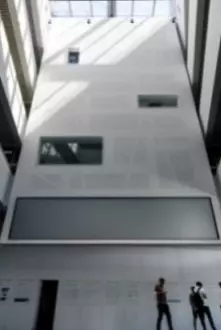
All four floors are connected by a central, light-filled atrium. A particularly impressive feature is the "Great Vertical", a "floating" wall that extends up to the roof. Photos: Foerderraum, Henry Koch
Challenges of a large-scale project
"The seven-month delay to construction work due to ordnance clearance was just one of the many challenges posed by this large-scale project", says Burkhard Okel, Managing Director of Okel GmbH & Co. KG. "For example, we repeatedly had to redevelop the construction schedule because the open façade largely prevented interior work during the winter, causing disruptions to the construction process between the installation of technical building equipment and the work of interior construction trades. Due to the continuous, temperature-independent installation of building services, standard fire protection seals were no longer possible in most cases, necessitating the use of complex drywall constructions."
"The acoustic requirements were particularly high", says construction manager Mirko Rohdenburg. "We fully met the requirements of the room acoustics report and DIN 4109 through louvred ceilings with acoustical baffles mounted on the upper side, perforated gypsum ceilings and walls, and mineral fibre ceilings with concealed substructures. Subsequently, an external engineering office conducted measurements and confirmed the results."
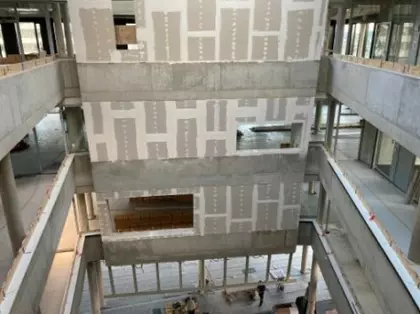
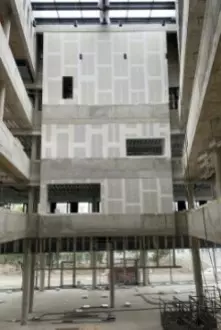
The "Great Vertical" is a sound-absorbing wall construction that extends from the ground floor to the roof. It is partially made of F90 and has a vertical inclination of about six degrees, following the floor levels. Photos: Okel GmbH & Co. KG
The "Great Vertical" of the atrium
One of the greatest challenges was the installation of the "Great Vertical" in the atrium. This vertical sound-absorbing wall construction, which is partially made of F90 material, extends from the ground floor to the roof. It follows the floor levels with a vertical inclination of about six degrees. The sound-absorbing wall, which appears to be floating, is tilted by approximately two metres. A key aspect of the steel substructure was ensuring that it could safely support the weight of the large monitor wall installed in the lower section.
The 18-metre-high wall was constructed using a 21-metre-high freestanding acoustic lining shell (Rigips System VS11RTA). Prior to installation, a 3D laser scan was performed on the atrium's shell. "Using the obtained data and point cloud, we were able to design the necessary steel substructure for the gypsum construction and manufacture it in the workshop, ensuring precise installation", explains Mirko Rohdenburg. "The cantilever arms consist of 900 mm long HEA 100 steel beams on which upper chords were mounted to serve as ceiling and floor connections for the acoustic cladding shell." According to the architects' plans, the wall incorporates several large F90 soundproof windows with fire-resistant glazing and fall protection, as well as a 6 mm thick steel sheet frame.
To optimise sound absorption, the wall was clad with a suspended, ventilated covering made of Rigitone Activ’Air 6/18 R, a highly effective perforated gypsum board from RIGIPS. These boards are ideal for creating diverse designs with high-quality, seamless surfaces and were also used to clad the balustrades and ceilings in numerous offices. The boards feature the premium air purification effect "Activ’Air" and are equipped on the back with laminated acoustic fleece, ready for immediate use. Thanks to the special active complex, solutions equipped with "Activ’Air" from RIGIPS eliminate air pollutants such as formaldehyde sustainably, thereby permanently improving indoor air quality. 'We fully met the specifications from the acoustic reports with the Rigitone Activ’Air on the slanted wall and balustrade, ensuring excellent speech intelligibility in the foyer and atrium", says Mirko Rohdenburg. The design of the large surface featuring widely branched, spackled areas of the perforated boards is particularly successful. This resulted in a challenging, handcrafted pattern reminiscent of a network.
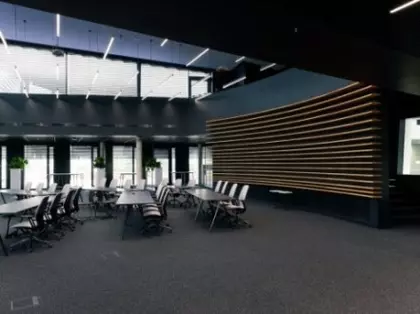
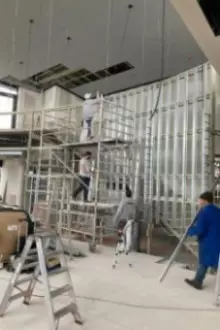
The impressive "HCCC – Hybrid Collaboration Conference Centre", equipped with state-of-the-art information and communication systems, occupies the central space of the new building on the third floor. The interior construction team's main challenge was executing the acoustically enhanced curved louvre wall in the conference area. Photos: Foerderraum, Henry Koch
The basic steel substructure was made up of square tubes that were fastened together using flange plates and sliding elements. To meet the sound absorption requirements, the gypsum surfaces were designed as acoustically resonant membranes incorporating hat channel rails. Rigips GK-Form 6 mm flexible gypsum board was used, featuring a closed surface and ideal for creating curved wall and vaulted ceiling systems without fire protection requirements, as well as dry and pre-moistened formability. Photo: Okel GmbH & Co. KG
Central element: the "Fraunhofer" room
The impressive "HCCC – Hybrid Collaboration Conference Centre", also known as the "Fraunhofer" room, occupies the central space of the new building on the third floor and is equipped with state-of-the-art information and communication systems. The interior construction team's main challenge was executing the acoustically enhanced curved louvre wall in the conference area. Its basic steel substructure was made from square tubes fastened with flange plates and sliding elements. To meet the sound absorption requirements, the gypsum surfaces were designed as resonant acoustic membranes with hat channel rails. Rigips GK-Form 6 mm flexible gypsum board was used for this purpose. It features a closed surface, dry and pre-moistened formability, and is ideal for creating curved wall and vaulted ceiling systems without fire protection requirements. To enable the wall surface to absorb and process sound waves, the round cladding construction was decoupled from the supporting structure. The wooden louvres were invisibly mounted following the curve of the wall in a horizontal grid pattern.
Another notable feature of the wall construction is the integrated ventilation system, which is routed through floor channels in the hollow floor and terminates in wall-integrated displacement air outlets. Perfectly coordinated with the room's furnishings and design, the interior construction team of Okel GmbH & Co. KG also implemented black, revisable mineral fibre ceilings, executed with a system-specific substructure made of acoustic aluminium U-profiles and acoustically highly effective louvers.
Escape tunnel in the stairwell
To ensure that the research institute can be evacuated quickly and safely in the event of a fire or other emergency, a secured escape corridor has been installed in the building's interior stairwell. Crossing a highly installed corridor ceiling, it was constructed using hollow profile steel beams measuring 120 x 80 x 5 mm and four-sided lining made from the special fire protection board Rigips Glasroc F (according to the Rigips detail sheet BS24GT). Thanks to its classification as a glass‑fibre‑reinforced gypsum board that complies with DIN EN 15283-1, the high-performance fire protection board of type GM-FH2 offers maximum safety when planning and executing structural cladding and fire protection constructions, such as installation ducts, shaft walls and ceilings. Its improved structural cohesion enables highly efficient constructions to be created, as Rigips Glasroc F remains stable and crack-free even after prolonged exposure to fire. The interior construction team executed the tunnel ceiling as a self-supporting suspended ceiling (F90) with integrated fire protection housings for recessed lights (Rigips System FD22GR). The cladding was also carried out using Glasroc F fire protection boards from Rigips.
Outstanding achievements
The jury of the 13th Rigips Trophy 2021 I 2023 was more than impressed by the performance of the interior construction team from Diemelstadt: once again, Okel GmbH & Co. KG has demonstrated its ability to handle challenging large-scale projects. The jurors praised the sophistication of the eye-catching constructions and the numerous interior details that often become invisible once the project is complete. The variety of materials and design elements were purposefully employed to enhance the building's overall impression. The interior construction professionals built on their success at the 13th Rigips Trophy by winning the SAINT-GOBAIN GYPSUM International Trophy 2023. With the winning Trophy project, Okel GmbH & Co. KG triumphed over 73 of the best interior construction projects from 27 countries to secure the silver trophy in the Non-Residential category.
Construction Details:
Client: Fraunhofer-Gesellschaft zur Förderung der angewandten Forschung e. V.
Architect: HHS-Planer + Architekten AG, Kassel
Drywall Construction: Okel GmbH & Co. KG, Diemelstadt
Rigips Regional Manager: Henning Häusler, SAINT-GOBAIN RIGIPS GmbH
SAINT-GOBAIN RIGIPS GMBH
RIGIPS. You have the solution for everything. #RigipsForEverything
Recognised as a system provider of high-quality drywall solutions by construction professionals, RIGIPS offers a wide range of gypsum and speciality boards, Rigidur gypsum fibreboards, profiles and accessories, as well as high-performance joint fillers and compounds. The tested solutions prove their worth in interior and exterior drywall constructions. Particularly, the system offerings for weather-protected façade constructions make RIGIPS the ideal partner for timber frame construction. With its continually expanding range of healthy-living products and highly effective fire and soundproofing systems, the manufacturer stands for maximum safety and comfort. The comprehensive product and system portfolio is complemented by a wide range of services and personalised expert advice, providing valuable support in the planning and execution of even the most demanding construction projects. At the same time, RIGIPS is committed to environmental responsibility, focusing on sustainable climate protection and the conservation of natural resources. For instance, gypsum board recycling options increasingly close material cycles, while product packaging made from recycled materials reduces the need for primary raw materials. RIGIPS has repeatedly been recognised as a "Brand of the Century" and is one of the most significant brands for modern drywall solutions in the German market. The company is part of the international Saint-Gobain Group.
In a nutshell: Rigips® – for better building for the benefit of people and the environment.
ABOUT SAINT-GOBAIN
As a global leader in sustainable lightweight construction, Saint-Gobain develops, produces, and distributes materials and services for the construction sector and industrial markets. Its integrated solutions for the renovation of public and private buildings, lightweight construction, and the decarbonization of the construction sector and industry are developed through a continuous innovation process. They offer sustainability and performance. The Saint-Gobain Group and all its brands are driven by the shared purpose of "MAKING THE WORLD A BETTER HOME".
- €51.2 billion in revenue in 2022
- More than 168,000 employees, represented in 75 countries
- Committed to achieving CO2 neutrality by 2050
Find out more about Saint-Gobain at www.saint-gobain.de
and follow us on LinkedIn Saint-Gobain Germany.
Further Information:
SAINT-GOBAIN RIGIPS GMBH
Schanzenstraße 84
40549 Düsseldorf
P.O. Box 11 09 48
40509 Düsseldorf
Phone: 02 11 / 55 03-0
Fax: 02 11 / 55 03-208
[email protected]
Editorial contact:
baumarketing.com GmbH
Christoph Tauschwitz
Laubenweg 13
D-45149 Essen
Tel.: +49 201 2202 400
Fax: +49 201 2202 460
[email protected]