

Impressive new museum building: House of Bavarian History
12th RIGIPS Trophy 2019 I 2020: A.S.T. Sommer GmbH awarded the golden trophy for outstanding interior design
There are only a few people for whom the word "Bavaria" does not conjure up an image of some kind. Whether it's the castle-loving King Ludwig II, Oktoberfest or the Olympic Games in Munich, all of these have shaped Bavarian history and are thus essential parts of the "House of Bavarian History", which opened in Regensburg in June 2019. This state-of-the-art museum comprises two complexes and is dedicated to conveying recent Bavarian history in the most personally engaging way possible. A.S.T. Akustik-, Stuck- und Trockenbau Sommer GmbH from Kirchdorf am Inn secured victory in the 12th RIGIPS Trophy 2019–2020 with their visually impressive and architecturally demanding interior, which uses modern drywall systems.
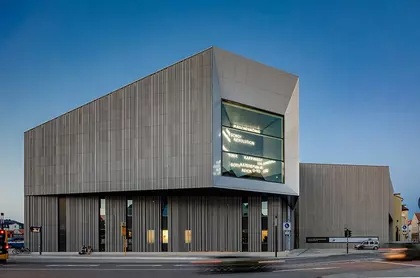
With their design for a modern museum building, the Frankfurt architectural firm wörner traxler richter impressed in a worldwide open architecture competition with more than 250 participants. Photo: Frank Blümler
The original idea goes back to 1983. At that time, the "House of Bavarian History" was founded as an official authority of the Free State of Bavaria. Since then, the main task of the House of Bavarian History has included the successful Bavarian State Exhibitions, which are presented each year in a different region of Bavaria on a specific topic of Bavarian history. In 2008, the idea also arose to give the House of Bavarian History its own "house" in the literal sense, and to develop a concept for a permanent exhibition site.
During a statewide application process in Bavaria, this location was found in the heart of Regensburg: directly on the banks of the Danube, it was possible to construct a building ensemble that harmonises perfectly with the historic Regensburg Old Town, which has been recognised as a UNESCO World Heritage Site since 2006. With their design for a modern museum building, the Frankfurt architectural firm wörner traxler richter impressed in a worldwide open architecture competition with more than 250 participants.
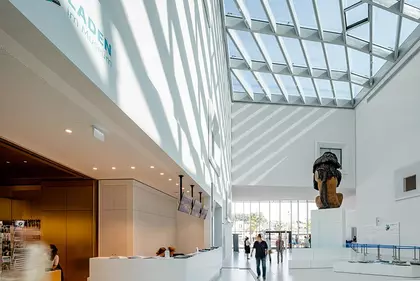
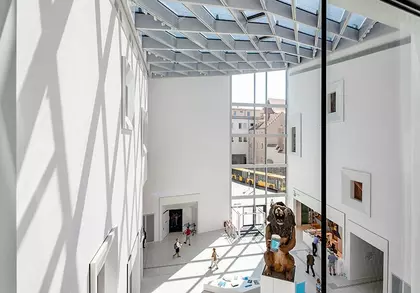
The glass roof, which symbolises the white and blue lozenges of the Bavarian state coat of arms, creates a light-filled atrium where visitors are greeted by the "Oktoberfest Lion". The biggest challenge for A.S.T. Sommer GmbH's drywall installers was that the lighting required absolutely smooth, flawless surfaces. As in almost all public areas, Q4 was required here, and almost 10,000 kg of Rigips joint filler was used, ranging from SUPER joint filler to ready-mixed ProMix Finish. Photos: Frank Blümler
The building interior traces the historic city structure
As you approach the museum, the connection to the urban context quickly becomes clear. With their multiple-folded roofs, the two structures – the actual museum and the adjacent Bavariathek – blend into the lively silhouette of Regensburg’s Old Town. The exterior of the building, constructed using steel and reinforced concrete, is clad with a ceramic façade whose vertically structured appearance responds to the yellow-grey natural stone of the newly designed open spaces.
The museum's interior also directly relates to the historic city structure: the central foyer traces the former Hunnenplatz, which stood at this very spot, as well as the historic Eschergasse. A steel-glass structure of about 700 m² spans the foyer and passageway at a height of 17 meters. The glass roof – symbolising the white and blue lozenges of the Bavarian state coat of arms – creates a light-filled atrium where visitors are greeted in style by the "Oktoberfest Lion".
"The interior construction of the foyer already illustrates two of the greatest challenges we faced throughout the entire construction process", reports Heinrich Sommer, Managing Director of A.S.T. Akustik-, Stuck- und Trockenbau Sommer GmbH. "On the one hand, our staff often had to work at great heights, mostly in rather confined spaces, since many trades were working simultaneously, which meant numerous scaffolds had to be erected in limited space. On the other hand, the large glass surfaces, of course, required special attention to the flatness and surface quality of the high, wall-hung facing boards, as extreme incident light was expected. Here, as in almost all public areas, Q4 was required; accordingly, nearly 10,000 kg of joint filler were used – from RIGIPS SUPER joint filler to ready-mixed ProMix Finish."
The rest of the material list also shows the scale of the interior construction project: around 28,000 m² of drywall boards were installed for wall and ceiling cladding—from classic Rigips RB boards and Glasroc F fire protection boards to cement-bound moisture-resistant boards. The complex substructures consisted of about 15,000 linear meters of CW profiles (RigiProfil MultiTec), 6,000 linear meters of UW profiles, and around 2,600 linear meters of ceiling profiles.
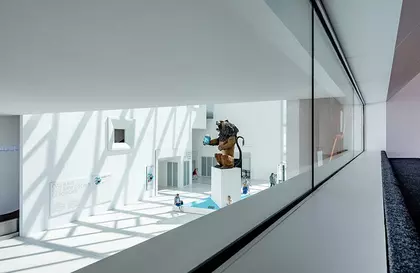
The verdict of the jury of the 12th RIGIPS Trophy 2019 I 2020 was clear: The employees of A.S.T. Sommer GmbH have created rooms in the House of Bavarian History that convince with their clean lines. Photos: Frank Blümler
Stairway with that certain “extra”
From the foyer, visitors first find a museum-owned tavern, the museum shop, and the large, divisible “Danube Hall,” which is used for special exhibitions and events. Also on the ground floor is the so-called Panorama Room, where brief film sequences on a 360-degree multivision screen introduce the early epochs of Bavarian history. A visitor reaches the upper floor via an escalator, where the permanent exhibition spreads across roughly 2,500 m² with an impressive ceiling height of 11 meters. “For entirely personal reasons, I recommend all visitors pay attention to the staircase leading back to the foyer at the end of the tour,” explains Heinrich Sommer with a smile. And rightfully so: The drywall team of A.S.T. integrated a handrail and continuous light coves for indirect lighting into the foyer staircase. “Via this staircase, aside from the bright, large foyer, you return to the ground floor in an almost intimate way,” says Heinrich Sommer.
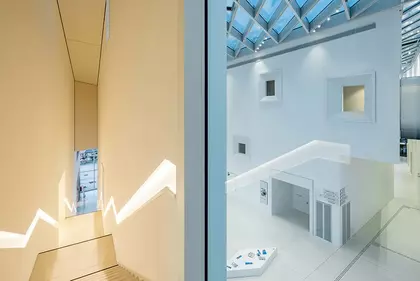
Stairway with that certain “extra”. Photo: Frank Blümler
“How Bavaria became a Free State and what makes it special”
Under this motto, the permanent exhibition traces Bavaria’s path to becoming a modern state – from the beginning of the Kingdom in 1806 to the present day. Unique is the manner of presentation: exhibit ensembles on 40 stages tell the story of defining events and phenomena in Bavarian history. In eight so-called cultural cabinets, cultural phenomena especially associated with Bavaria are presented, from dialects to festivals to religion. Altogether, approximately 1,000 exhibits are presented, about a third of which are from Bavarian citizens themselves. This is one reason the House of Bavarian History is also known as a Citizen’s Museum.
The permanent exhibition includes not only everyday items but also several showpieces such as King Ludwig II's sled or the monumental parliamentary carpet from the former plenary hall of the Bavarian State Parliament. Its presentation, says drywall expert Heinrich Sommer, is a good illustration of the special challenges that museum buildings pose, especially for interior construction: “The carpet was to be displayed hanging on a 7-meter-high, freestanding drywall wall with a vertically inclined surface. When you realise that the historic parliamentary carpet weighs about 600 kg, it becomes clear what forces are at work on the mounting points and the entire wall construction,” explains Heinrich Sommer.
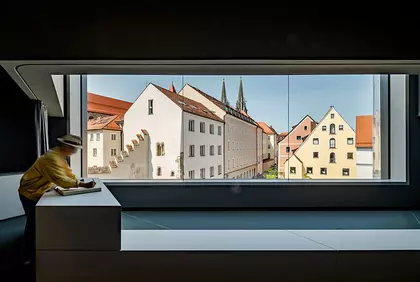
Again and again, the House of Bavarian History surprises its visitors with unexpected and impressive views. At the rear end of the permanent exhibition, the striking 80 m² cathedral window reveals a magnificent view of Regensburg’s Old Town and the cathedral towers. Photo: Frank Blümler
6,000 kg at four anchoring points
The in-house structural engineering office of A.S.T. Sommer GmbH carried out the structural calculation of the exhibition wall based on preliminary planning. The core of this special load-bearing construction is an aluminium frame. One of the challenges was that the final 8.3-metre-wide wall could only have four anchoring points at the bottom. In the event of any redesign of the exhibition or repositioning of exhibits, the structure should have as few drilled holes as possible. "For each anchoring point, we first set a bonded M16 anchor into the raw ceiling. The completely freestanding wall is stiffened in the transverse direction by the rigidly welded aluminium frames. In the longitudinal direction, we achieved a board structure on the inclined side using additional multiplex boards. Further diagonal stiffeners made from hat ceiling profiles 96/15 were added to the substructure on the rear of the wall. Finally, the multiplex-clad side was covered in a single layer, while the other side was double-layered with Rigips RB boards. The overall weight of the wall constructed in this way is approximately 6,000 kg."
In addition to this structurally challenging special construction, Heinrich Sommer and his drywall team’s "signature" can be found throughout the museum: following the folded roofs, there are numerous facing boards and walls in varying arrangements with many corners and changing angles – all executed in the highest surface quality. Equally important to the visual impression is a constant indoor climate. The building was constructed according to passive house standards, with the museum’s use requiring a stable indoor climate with constant humidity and room temperatures between 18 and 20°C in winter and 23 to 25°C in summer. To ensure even temperature distribution and continuous air exchange, A.S.T. Sommer GmbH employees integrated numerous ventilation outlets into the wall constructions.
The constructions realised in the House of Bavarian History demonstrate, according to the jury of the 12th RIGIPS Trophy 2019 I 2020, the strengths of drywall – as a creative tool as well as a guarantor for meeting special structural and architectural requirements. Photos: Frank Blümler
The experts agree
The verdict of the jury of the 12th RIGIPS Trophy 2019 I 2020 was clear: The employees of A.S.T. Sommer GmbH have created rooms in the House of Bavarian History that convince with their clean lines. The realised constructions, according to the jury, demonstrate the strengths of drywall – both as a design tool and as a guarantee for compliance with special structural and construction requirements.
Site Board
Client: Free State of Bavaria, represented by the State Building Authority Regensburg
Planning: wörner traxler richter planungsgesellschaft mbH, Frankfurt am Main | Dresden | Munich
Interior Construction Company: A.S.T. Akustik-, Stuck- und Trockenbau Sommer GmbH, Kirchdorf am Inn
Drywall Systems Consultant: Bernd Fischer, Saint-Gobain RIGIPS GmbH
SAINT-GOBAIN RIGIPS GMBH
RIGIPS. You have the solution for everything. #RigipsForEverything
Recognised as a system provider by construction professionals for its high-quality drywall solutions, RIGIPS offers a wide range of gypsum and speciality boards, Rigidur gypsum fibre boards, profiles, accessories and high-performance fillers and joint compounds. These tried-and-tested solutions have proven their effectiveness in interior and exterior drywall construction. In particular, our range of systems for weather-protected façade constructions makes us the ideal partner for timber frame construction projects. With its ever-expanding range of products for healthy living and its highly effective fire and sound protection systems, the manufacturer delivers maximum safety and comfort. This extensive product and system portfolio is complemented by a broad range of services and personal expert consultation, providing valuable support in planning and executing even the most demanding construction projects. At the same time, RIGIPS is committed to environmental responsibility, focusing on sustainable climate protection and the conservation of natural resources. For instance, gypsum board recycling solutions are closing material cycles, and packaging made from recycled materials is reducing the need for primary raw materials. RIGIPS has been recognised multiple times as a Brand of the Century and is one of the most important brands for modern drywall solutions in the German market. The company is part of the international Saint-Gobain Group.
In a nutshell: Rigips® – building better for people and the environment.
ABOUT SAINT-GOBAIN
As a global leader in sustainable lightweight construction, Saint-Gobain develops, manufactures and distributes materials and services for the construction and industrial sectors. Its integrated solutions for renovating public and private buildings, lightweight construction and decarbonising the construction and industrial sectors are developed through continuous innovation. These solutions offer both sustainability and performance. The Saint-Gobain Group is guided by its purpose: "MAKING THE WORLD A BETTER HOME".
- €51.2 billion in sales in 2022
- More than 168,000 employees in 75 countries
- Committed to achieving CO2 neutrality by 2050
Find out more about Saint-Gobain at www.saint-gobain.de
and follow us on LinkedIn Saint-Gobain Germany.
Further information:
SAINT-GOBAIN RIGIPS GMBH
Schanzenstraße 84
40549 Düsseldorf
P.O. Box 11 09 48
40509 Düsseldorf
Telephone 02 11 / 55 03-0
Telefax 02 11 / 55 03-208
[email protected]
Editorial contact:
baumarketing.com GmbH
Christoph Tauschwitz
Laubenweg 13
D-45149 Essen
Tel.: +49 201 2202 400
Fax: +49 201 2202 460
[email protected]