

At home in Saarmund: sustainable timber construction creating living space for the future
Largest residential construction project in Brandenburg using timber construction successfully completed
It is a pioneering example of sustainability and energy efficiency: over the past few months, a barrier-free, four-storey apartment building with 98 residential units has been constructed in Saarmund, near Potsdam. This will ensure that its future tenants can enjoy a self-determined and independent life in their own home well into old age. For the developer, the Berlin-based Gokom Immobiliengruppe, which established the Daheim in Saarmund GmbH specifically for this project, two aspects were central to the planning and realisation of the development: social and ecological sustainability. To meet these high standards, the building envelope was constructed using timber panels according to the Efficiency House 40 Plus standard under the BEG guidelines. This construction project is pioneering in Brandenburg and will serve as an example for future projects.
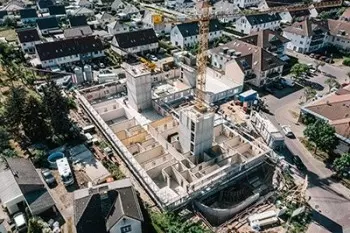
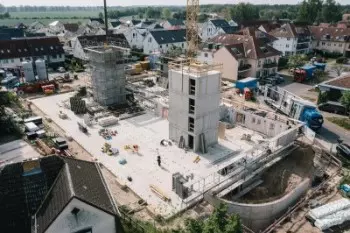
Construction began with the underground garage, foundation and solid staircases. Thanks to the prefabrication of innovative timber constructions, "Daheim in Saarmund" grew floor by floor within just a few weeks.
It has almost become a truism that the cheapest energy is that which is not consumed at all. However, even the most frugal person cannot do without electricity and thermal energy entirely. The residents of the new apartment building in Saarmund are therefore fortunate, as the developer and planners focused equally on generating ecological energy and achieving maximum energy efficiency. This has successfully kept ancillary costs manageable and predictable in the long term, even in the face of sharply rising energy prices.
Specifically, highly efficient air-to-water heat pumps were used alongside local electricity generation via a 134 kW peak photovoltaic system with battery storage on the building's flat roof. The latter ensures a power supply for the entire building and its individual apartments. This allows tenants to access locally generated electricity from their "own" roof and monitor their consumption around the clock. This is made possible by a special electricity tariff for tenants from the energy provider Polarstern, which offers tenants locally generated electricity at a reduced rate.
Inherently sustainable
In addition to its modern technical equipment, the building itself ensures "top marks" in terms of sustainability. Its dimensions alone are impressive: It has approximately 2,600 m² of exterior walls, nearly 7,000 m² of interior walls and around 6,650 m² of ceiling surfaces. Approximately 160 m³ of structural timber was processed for this purpose. A significant advantage of the chosen timber construction method is already evident here. The installed timber has permanently stored around 1,600 tonnes of CO₂, while the timber required for the entire construction project regrows in German forests in just 12 hours. In times of scarce and expensive raw materials, this is a compelling argument for this construction method," explains Josef Niehues, the technical project manager responsible for implementing "Daheim in Saarmund" at timber construction specialist KAMPA.
Thanks to his extensive knowledge, the timber construction professional can list a variety of project-specific advantages: "All timber elements were prefabricated in just five production weeks, and the four storeys were erected in only three months. Since the construction site was adjacent to existing developments, space was limited and local traffic made logistics challenging. Therefore, the regional proximity of the KAMPA house manufacturing facility in Freiwalde to the construction site was particularly advantageous in terms of transport savings and short communication paths. All wall elements were prefabricated in Freiwalde, while the solid ceiling elements were delivered from our nearby facility in Werder ", says Josef Niehues.
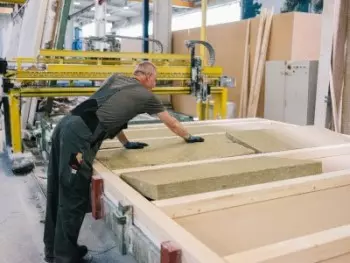
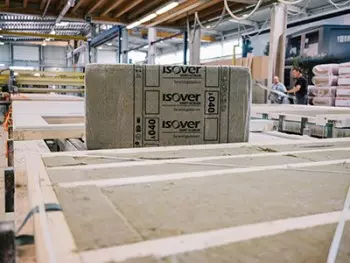
Special wall and ceiling constructions were developed in collaboration with project partners ISOVER and RIGIPS to meet the strict requirements of the K260 encapsulation. The interior and apartment partition walls were constructed using a combination of Rigips RF fire protection boards and non-combustible stone wool insulation materials (ISOVER Protect BSP 40).
A pioneering role in fire protection
In addition to the high physical building requirements, which are exemplified by this project and will set the standard for future construction projects, pioneering work was required in Brandenburg, where timber construction standards similar to those in the southern federal states had not yet been implemented. Due to the stringent fire protection requirements for building class 4 (buildings up to 13 metres high) and the necessary energy efficiency standard KfW 40 under BEG, innovative construction solutions and meticulous execution were essential. "The timber construction guideline for multi-storey construction was only introduced in Brandenburg in 2022. Almost all ceiling and wall constructions, therefore, had to meet the K260 fire protection encapsulation criteria. This means that all timber components must withstand flames during a building fire for at least 60 minutes. Even under direct fire exposure, the cladding of the timber components must not collapse and the temperature behind the fire protection cladding must not exceed an average of 250°C," explains Niehues.
To meet the strict K260 encapsulation requirements, special wall and ceiling constructions were developed in collaboration with project partners ISOVER and RIGIPS. They not only provide maximum fire safety, but also contribute significantly to the components' high energy efficiency and soundproofing quality. "Achieving the encapsulation criterion according to the certification requirements of the Material Testing Institute for Construction – Timber Construction Department – Monitoring and Certification Office, Technical University of Munich, is fundamentally only possible with non-combustible insulation materials of Euroclass A1 with a melting point greater than 1,000°C. Based on this, all exterior walls are constructed from the inside out as follows: The inner cladding consists of a Rigips RB construction board, followed by a 50 mm wide installation layer. Two layers of 18 mm-thick Rigips RF fire protection boards then protect the 200 mm stud frame with cavity insulation made of ISOVER ULTIMATE ZKF-031. On the outside, the insulated stud frame is clad again with two 18 mm Rigips RF fire protection boards, which are then supplemented with a 120 mm thick thermal insulation composite system," explains Niehues.
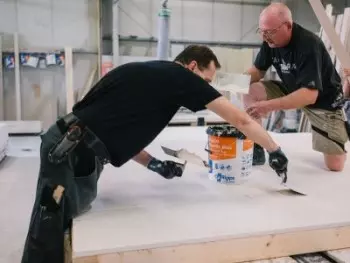
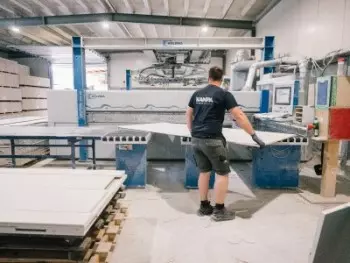
When combined with double-layer cladding on both sides using 18 mm Rigips RF fire protection boards, highly efficient exterior wall constructions are achieved. All fire protection requirements were reliably met, and the required U-value of 0.11 W/(m²K) was achieved with a comparatively slim wall construction. Additionally, the soundproofing requirements of R'w,ges ≥ 42 dB for certain areas of the façade were easily met.
Non-combustible high-performance mineral wool plus fire protection board encapsulation
The combination of Rigips RF fire protection boards for fire-safe cladding and non-combustible ULTIMATE cavity insulation made of high-performance mineral wool (thermal conductivity value = 0.031 W/(m²K); non-combustible A1; melting point >1,000°C; and AFr >25 kPa) enables highly efficient exterior wall constructions to be achieved in every respect. All fire protection requirements were reliably met, and the required U-value of 0.11 W/(m²K) was achieved with a comparatively slim wall construction. Additionally, the soundproofing requirements of R'w,ges ≥ 42 dB for certain areas of the façade were easily met.
For interior walls and apartment partitions with increased soundproofing requirements, Rigips fire protection boards were combined with non-combustible ISOVER insulation solutions. The interior walls of the apartments were constructed with a 100 mm stud frame, ISOVER Protect BSP 40 stone wool insulation and double-layer cladding on both sides with 18 mm Rigips RF (or impregnated RFI) fire protection boards. In contrast, the apartment partition walls were designed with two 80 mm stud frames and a 10 mm wide cavity. These frames were filled with non-combustible ISOVER stone wool and the walls were clad on both sides with two 18 mm Rigips RF fire protection boards.
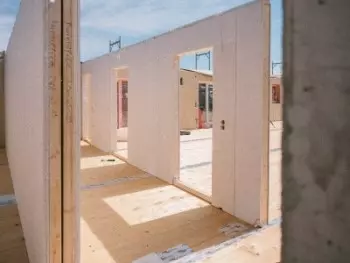
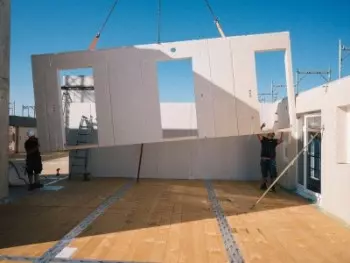
As the construction site was adjacent to existing developments, space was limited and local traffic made logistics challenging. Therefore, the proximity of the KAMPA manufacturing facility to the construction site was particularly advantageous in terms of transport costs and communication efficiency. Construction of the four-storey building was completed in just three months.
Permanent flat roof monitoring for maximum safety
While the exterior walls achieved a U-value of 0.11 W/(m²K), the flat roof of the apartment building required a value of 0.9 W/(m²K). The necessary thermal protection was provided by 260 mm of base insulation and gradient insulation (460 mm at the highest point of the gradient) placed on top. Both have sufficient load-bearing capacity to safely support the photovoltaic system installed subsequently.
Additional safety in the flat roof structure is provided by innovative roof sensor technology for moisture monitoring. A total of nine ISOVER GUARD SYSTEMS were installed across the 1,600 m² roof area. These monitoring units consist of highly sensitive roof sensors, GSM transmission modules and a web-based analysis tool. All relevant data on moisture in the roof, as well as indoor and outdoor temperatures, is continuously recorded and automatically evaluated using a reference database. The GUARD SYSTEM enables precise tracking of moisture accumulation in the roof structure. All registered users, such as the building maintenance service responsible for the property, can access the available measurement data in the web portal at any time. As the system automatically sends an email alert in real-time as soon as the moisture accumulation reaches a critical level, regular monitoring is not necessary. Only the affected sensor triggers an alarm, enabling potential leaks in the roof sealing to be pinpointed.
"Early detection of potential damage is particularly important for flat roofs with load-bearing shells made of timber components, such as those in Saarmund, in order to react quickly and keep repair efforts as minimal as possible", explains Mark Wagner, the responsible product manager at ISOVER who oversaw the installation of the GUARD SYSTEMS. '"Moisture measurement via the sensors takes place above the vapour barrier, so the sensors should be placed more centrally within the roof area in gradient insulation. However, if the gradient is created by the base surface, the sensors should generally be placed in the gradient valleys, as moisture penetration will first become noticeable there."
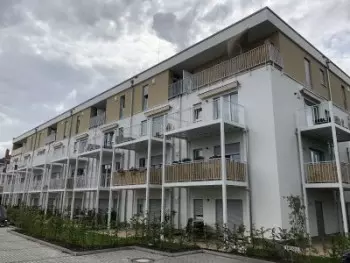
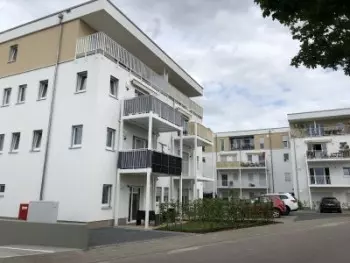
It is a pioneering example of sustainability and energy efficiency. Over the past few months, a barrier-free, four-storey apartment building with 98 residential units has been constructed in Saarmund near Potsdam. This will ensure that its future tenants can enjoy a self-determined and independent life in their own home well into old age.
A model for contemporary construction and living
For Josef Niehues from KAMPA, the fully barrier-free building — accessible from the underground garage to the top floor — is, above all, a model of contemporary construction and living in the context of demographic change and growing energy uncertainty. "Our construction project in Saarmund is not only energy crisis-proof and cost-effective to run, but it also offers its residents state-of-the-art building technology and comfortable living spaces. Each apartment, for example, is equipped with a fresh air system with heat recovery to ensure optimal indoor air quality. Mould and cross-ventilation on cold winter days are thus a thing of the past. All apartments are also heated via low-temperature underfloor heating with individual room control. This is not only very energy-efficient, but also provides a pleasant, consistent warmth throughout the apartments."
Further information:
www.kampa.de/news/barrierefreies-wohnen-in-saarmund/
www.isover.de/holzbau
www.rigips.de/holzbau
Construction progress in time-lapse:
www.youtube.com/watch?v=Mk_OwA1ImLk
Construction board:
Developer: Gokomm Immobiliengruppe / Daheim in Saarmund GmbH, Berlin
Planning: Friedrich-W. Groefke Planungs GmbH, Berlin
Timber construction: KAMPA GmbH, Aalen-Waldhausen
Insulation / Roof sensor technology / Drywall: SAINT-GOBAIN ISOVER G+H AG / SAINT-GOBAIN RIGIPS GmbH, Düsseldorf
SAINT-GOBAIN RIGIPS GMBH
RIGIPS. You have the solution for everything. #RigipsForEverything
Recognised as a system provider of high-quality drywall solutions by construction professionals, RIGIPS offers a wide range of gypsum and speciality boards, Rigidur gypsum fibreboards, profiles and accessories, as well as high-performance joint fillers and compounds. The tested solutions prove their worth in interior and exterior drywall constructions. Particularly, the system offerings for weather-protected façade constructions make RIGIPS the ideal partner for timber frame construction. With its continually expanding range of healthy-living products and highly effective fire and soundproofing systems, the manufacturer stands for maximum safety and comfort. The comprehensive product and system portfolio is complemented by a wide range of services and personalised expert advice, providing valuable support in the planning and execution of even the most demanding construction projects. At the same time, RIGIPS is committed to environmental responsibility, focusing on sustainable climate protection and the conservation of natural resources. For instance, gypsum board recycling options increasingly close material cycles, while product packaging made from recycled materials reduces the need for primary raw materials. RIGIPS has repeatedly been recognised as a "Brand of the Century" and is one of the most significant brands for modern drywall solutions in the German market. The company is part of the international Saint-Gobain Group.
In a nutshell: Rigips® – for better building for the benefit of people and the environment.
ABOUT SAINT-GOBAIN
As a global leader in sustainable lightweight construction, Saint-Gobain develops, produces, and distributes materials and services for the construction sector and industrial markets. Its integrated solutions for the renovation of public and private buildings, lightweight construction, and the decarbonization of the construction sector and industry are developed through a continuous innovation process. They offer sustainability and performance. The Saint-Gobain Group and all its brands are driven by the shared purpose of "MAKING THE WORLD A BETTER HOME".
- €47.9 billion in revenue in 2023
- More than 160,000 employees, represented in 76 countries
- Committed to achieving CO2 neutrality by 2050
Find out more about Saint-Gobain at www.saint-gobain.de and follow us on LinkedIn Saint-Gobain Germany.
Further information:
SAINT-GOBAIN RIGIPS GMBH
Schanzenstraße 84
40549 Düsseldorf
Postfach 11 09 48
40509 Düsseldorf
Phone: 02 11 / 55 03-0
Fax: 02 11 / 55 03-208
[email protected]
Editorial contact:
baumarketing.com GmbH
Christoph Tauschwitz
Laubenweg 13
D-45149 Essen
Phone: +49 201 2202 400
Fax: +49 201 2202 460
[email protected]