

Impressive shapes – outstanding acoustics with Rigips
School centre event hall shines in new splendour and impresses with balanced acoustics
For around 35 years, the AGORA at the Uetze School Centre was the central venue for students, teachers and families. The 300 m² hall features a hexagonal parquet floor adjoining a stage beneath a tent-shaped roof. However, during an inspection of the pitched roof surfaces some time ago, several damaged areas were identified: leaks, partially displaced thermal insulation and, especially, an exposed and porous surface of the asbestos-containing corrugated sheet covering. This made extensive renovation work urgently necessary. It also became apparent that the installed steel beams would not be sufficiently protected from heat in the event of a fire and that, from a fire protection perspective, a wooden ceiling lining would no longer be permitted for a hall subject to the regulations of the Lower Saxony Assembly Venue Ordinance. Comprehensive renovation of the entire roof structure therefore seemed sensible. The AGORA's interior has become a real visual and acoustic highlight thanks to the concept of the Hanover-based architectural firm LSM and the high-quality interior design carried out by SKALA Akustik-Decken GmbH.
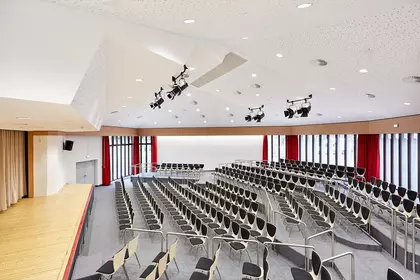
Today, the AGORA of Uetze impresses not only with its bright and friendly atmosphere and its exceptional spatial geometry. Reverberation times and clarity, both for music performances and spoken presentations, have also been significantly improved.
The old wooden cladding on the sloping ceiling and some of the walls of the hexagonal building certainly served its acoustic purpose. A preliminary study of the hall, which has a net room volume of approximately 1,540 m³, showed that the room acoustics were satisfactory. However, insufficient speech intelligibility was identified only in the rear seating areas. These findings were incorporated into the architects’ overall concept and played a significant role in the appearance of the new AGORA.
For Steffen Großmann, Technical Director of SKALA Akustik-Decken GmbH, the challenges began long before the first acoustic construction measures. "Unfortunately, there were hardly any precise existing plans except for an old, rather roughly executed ceiling plan from 1978", said Steffen Großmann. "That’s why, before dismantling the old wooden ceiling, we measured the entire ceiling structure with all its details exactly, to get a better planning basis."
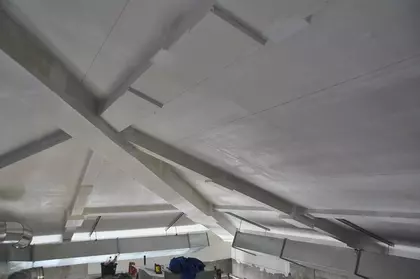
A maximum load of 31.6 kg/m² had to be adhered to for the extensive fire protection ceiling. As the cladding was to be made from an A1 board material, the fitting team also opted for Rigips Glasroc F fire protection boards.
"Legacy materials" professionally disposed of
Shortly after the start of the dismantling of the wooden cladding, insulation made from artificial mineral fibers of older construction years emerged. The further dismantling therefore had to take place with special occupational safety precautions. "We worked with an airlock system that prevented any dust from escaping. The work was carried out in a hermetically sealed space. The old insulation was securely packaged and then professionally disposed of", reported Andreas Lensch, project manager at SKALA Akustik-Decken GmbH.
In the next step, all TGA pipes in the roof area were removed to provide sufficient installation space for modern fire protection systems. The actual roof truss consists of wooden beams combined with a tent-shaped steel load-bearing structure. To safely accommodate additional loads, such as the fire protection cladding of the steel beams, the planned fire protection ceiling, and the acoustic ceiling below, the steel structure was reinforced by a carpentry firm with additional wooden beams. This allowed for the required, shorter fixing intervals for the F90 fire protection ceiling.
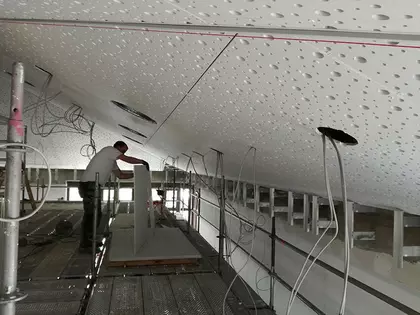
Creating the acoustic ceiling proved especially challenging due to its unusual geometry. The slanted roof surfaces combined with the stepped ceiling structure above the stage resulted in numerous axes and intersection points. These were carefully marked with strings to ensure exact and efficient installation of the ceiling construction. Using a board lifter, the Rigitone Air boards (random perforation 12/20/35 R) could be precisely aligned using the markings.
Prefabrication of steel beam cladding with Rigips fire protection boards
The exposed and reinforced roof truss first received insulation made from non-combustible mineral wool batts (240 mm) and a wind-tight PE vapour barrier (sd-value ³ 100 m). Afterwards, the team led by foreman Stefan Schröder focused on fireproofing the steel structure. The elements to be clad included steel beams (HEA 200 / HEB 700), compression bars (80 x 80 mm), and tension bands in angle shape (80 x 60 x 6 mm). "The fire protection requirement for all elements was F90. Depending on the U/A ratio for steel elements, the three-sided cladding was done as per Rigips System BS23GT with a single layer of Rigips Glasroc F fire protection board. To ensure the most efficient progress on site, most of the beam cladding was prefabricated in our workshop. The needed brackets for the beam flanges and the butt reinforcement were then constructed at the site", explains project manager Andreas Lensch.
Junctions where steel beams, compression bars, and tension bands met were doubled up to achieve the approved cladding thickness. Another challenge was round ventilation ducts passing through the beam cladding. At affected points, the cladding was doubled to ensure a tight connection. "Gradually, round infill pieces made from Glasroc F were produced and fitted into the reveals. Once the reveal was fully filled, the surfaces were sealed with Rigips VARIO joint filler. Afterwards, the ventilation contractor could carry out the necessary pipe penetrations."
A maximum load of 31.6 kg/m² had to be maintained for the extensive fire protection ceiling. As the cladding was to be made from an A1 board material, the fitting team also opted for Rigips Glasroc F fire protection boards. "Based on a Rigips report, we were able to reduce the board thickness by 5 mm, using 1 x 20 mm and 1 x 15 mm instead of 2 x 20 mm,' says Andreas Lensch. Thanks to the resulting weight savings, we could reliably comply with the maximum load requirement", says Andreas Lensch. Rigips direct hangers 0.4 kN were used to fasten the substructure, which consisted of Rigips CD profiles 60/27 as primary and load-bearing profiles.
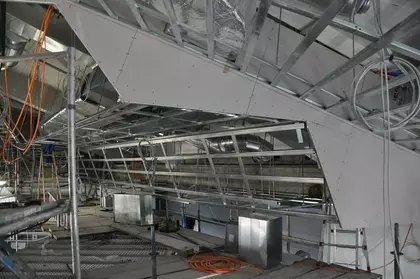
A visual highlight is the stepped ceiling above the stage. Its substructure consists of horizontal and vertical Rigips ceiling profiles supported by Nonius hangers. The individual steps are clad alternately with perforated boards for sound absorption and smooth Rigips construction boards for sound reflection (with a total area of about 78 m²), which are intended to improve speech intelligibility in the rear sections of the AGORA.
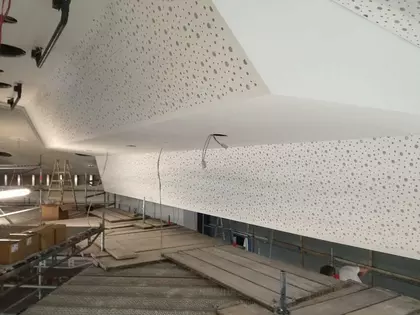
The acoustic ceiling creates visual highlights
A maximum additional load of 15 kg/m² was permitted for the acoustic ceiling surfaces to be installed next, including all installations such as speakers, smoke detectors and emergency lights. The acoustic ceiling was installed in accordance with the Rigips System AD10RTA. With hanger spacing of 750 mm, base profile axis spacing of 1,500 mm and single-layer cladding comprising Rigitone Air perforated boards and an insulation overlay, the surface weight achieved was 12.8 kg/m². Together with the calculated weight of the planned installations, which was 1.5 kg/m², the additional load was 14.3 kg/m², which fulfilled the static requirements optimally.
Creating the acoustic ceiling proved especially challenging due to its unusual geometry. "The slanted roof surfaces combined with the stepped ceiling structure above the stage resulted in numerous axes and intersection points. That’s why we carefully marked these with strings to ensure exact and efficient installation of the ceiling construction." Using a board lifter, the Rigitone Air boards (random perforation 12/20/35 R) were then precisely aligned along the markings.
The stepped ceiling above the stage became a visual highlight. Its substructure consists of horizontal and vertical Rigips ceiling profiles supported by Nonius hangers. The individual steps were clad alternately with sound-absorbing perforated boards and sound-reflecting, smooth Rigips construction boards RB (with a total area of about 78 m²), which were intended to improve speech intelligibility in the rear seating rows of the Agora. "To optimally implement the non-right-angled edges of the steps visually, we used the flexible Rigips EasyFlex edge protection. Its flexible, paper-wrapped PVC core allowed precise adaptation to the different edge angles and clean filling with Rigips ProMix ready-mixed filler", says Andreas Lensch.
Visually appealing expansion joints
To create as harmonious an overall appearance of the ceiling as possible, the fitting team paid special attention to the visually appealing transitions between individual ceiling surfaces. The planned expansion joints were backed with custom-bent sheet metal. A white PVC edging profile was placed on the board edges, and afterwards the galvanised, bent profile was coated white. To create the joint seams, employees of SKALA Akustik-Decken GmbH relied on the ready-mix system from Rigips. "Thanks to the special joint filler Rigitone Mix, the joints only needed minimal excess filling, so only light sanding was necessary. The usual final filling step could be omitted." After the ceiling surfaces were largely completed, the team led by foreman Stefan Schröder mounted sound-absorbing MDF wall boards with real wood veneer, further enhancing the room acoustics.
The AGORA of Uetze, now shining in new splendour, impresses today not only with its bright and friendly atmosphere and its exceptional spatial geometry. Reverberation times and clarity, both for music performances and spoken presentations, have also been significantly improved. Thus, a roof renovation that was essential from fire protection and building biology perspectives grew into a comprehensive modernisation, resulting in an assembly venue that would likely have delighted the ancient Greeks, after whom the term “Agora” for an assembly venue is named.
Construction Board
Client: Municipality of Uetze
Planning/Construction Management: LSM Architects, Hannover
Room Acoustics Planning: GTA Society for Technical Acoustics mbH, Hannover
Fitting Company: SKALA Akustik-Decken GmbH, Isernhagen
Drywall Systems Consultant: Dennis Pietrzyk, Saint-Gobain Rigips GmbH
SAINT-GOBAIN RIGIPS GMBH
RIGIPS. You have the solution for everything. #RigipsForEverything
Recognised as a system provider by construction professionals for its high-quality drywall solutions, RIGIPS offers a wide range of gypsum and speciality boards, Rigidur gypsum fibre boards, profiles, accessories and high-performance fillers and joint compounds. These tried-and-tested solutions have proven their effectiveness in interior and exterior drywall construction. In particular, our range of systems for weather-protected façade constructions makes us the ideal partner for timber frame construction projects. With its ever-expanding range of products for healthy living and its highly effective fire and sound protection systems, the manufacturer delivers maximum safety and comfort. This extensive product and system portfolio is complemented by a broad range of services and personal expert consultation, providing valuable support in planning and executing even the most demanding construction projects. At the same time, RIGIPS is committed to environmental responsibility, focusing on sustainable climate protection and the conservation of natural resources. For instance, gypsum board recycling solutions are closing material cycles, and packaging made from recycled materials is reducing the need for primary raw materials. RIGIPS has been recognised multiple times as a Brand of the Century and is one of the most important brands for modern drywall solutions in the German market. The company is part of the international Saint-Gobain Group.
In a nutshell: Rigips® – building better for people and the environment.
ABOUT SAINT-GOBAIN
As a global leader in sustainable lightweight construction, Saint-Gobain develops, manufactures and distributes materials and services for the construction and industrial sectors. Its integrated solutions for renovating public and private buildings, lightweight construction and decarbonising the construction and industrial sectors are developed through continuous innovation. These solutions offer both sustainability and performance. The Saint-Gobain Group is guided by its purpose: "MAKING THE WORLD A BETTER HOME".
- €51.2 billion sales in 2022
- More than 168,000 employees, represented in 75 countries
- Committed to achieving CO2 neutrality by 2050
Find out more about Saint-Gobain at www.saint-gobain.de
and follow us on LinkedIn Saint-Gobain Germany.
Further information:
SAINT-GOBAIN RIGIPS GMBH
Schanzenstraße 84
40549 Düsseldorf
P.O. Box 11 09 48
40509 Düsseldorf
Telephone 02 11 / 55 03-0
Fax 02 11 / 55 03-208
[email protected]
Editorial contact:
baumarketing.com GmbH
Christoph Tauschwitz
Laubenweg 13
D-45149 Essen
Tel.: +49 201 2202 400
Fax: +49 201 2202 460
[email protected]