

Earthquake safety
General construction approval for Rigidur H gypsum fibreboards as a single‑layer boarding material
Thankfully, images of severe damage to buildings or infrastructure caused by strong earthquakes are usually only seen on the news in this country. However, there are regions in Germany where consequential earthquakes are to be expected. DIN 4149 sets out the requirements for designing structures that can withstand a defined design earthquake and retain adequate residual load-bearing capacity even after the quake. Rigidur H gypsum fibre boards from RIGIPS have been granted a new general construction approval and are now classified as the sole sheathing material for transferring shear forces from seismic loads, which is particularly advantageous for timber and timber board construction.
More at: www.rigips.de/erdbeben-sicherheit
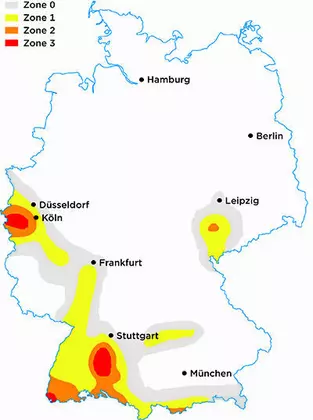
There are also regions in Germany where consequential earthquakes are to be expected. However, DIN 4149 sets out the requirements for designing structures that can withstand a defined earthquake and retain adequate residual load-bearing capacity afterwards. RIGIPS offers planners, architects and timber construction professionals a wide selection of boards with general construction approvals for designing and constructing load-bearing and non-load-bearing components in vulnerable areas. Photo: SAINT-GOBAIN RIGIPS GMBH
The corresponding graphic in DIN 4149:2005-04 explicitly designates large parts of North Rhine-Westphalia and Baden-Württemberg, as well as Bavaria and Thuringia, as 'earthquake zones' in Germany. Intensity intervals based on the European Macroseismic Scale (EMS) have been assigned to these zones. Other boundary conditions, such as subsoil properties or the geology of the building site, also inform the building-specific risk assessment.
To ensure the structural safety of buildings and components in the event of an earthquake, DIN 4149:2005-04, "Structures in German Earthquake Regions", currently applies in Germany. This standard covers load assumptions, as well as the design and construction of typical buildings. As part of the harmonisation of European standards, it is likely that Eurocode 8 "Design of Structures for Earthquake Resistance" will replace this national standard in the foreseeable future, as the two sets of standards are largely identical. Therefore, non-load-bearing components must be designed to prevent endangering people in the event of an earthquake:
- human life must be protected,
- damage must be limited, and
- critical structures for the protection of the population must remain operational.
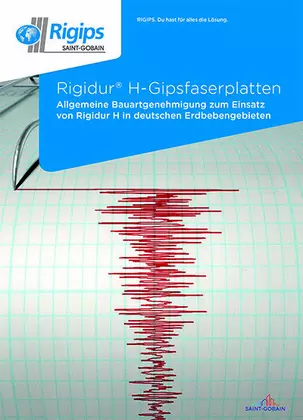
Thanks to the new general construction approval, Rigidur H gypsum fibre boards from RIGIPS can now be used as the sole sheathing material for transferring shear forces from seismic loads, which is particularly advantageous for timber and timber board construction. The manufacturer has compiled extensive information on the subject of earthquake safety at www.rigips.de/erdbeben-sicherheit. Alongside the general construction approvals, a 12-page "Technik Aktuell" is also available to download as a PDF. It contains detailed descriptions of principles for the design of earthquake-resistant components based on building codes and standards. Photo: SAINT-GOBAIN RIGIPS GMBH
Advantage of timber construction: absorbing and transferring earthquake forces
Timber construction, especially timber board construction, is a construction method that has proven to be particularly resilient in the event of potential seismic activity. This method is characterised by the ability of the load-bearing and bracing components to absorb earthquake forces and transform them into component deformations without collapsing.
A key feature of timber boards is the load-bearing and bracing sheathing made from board materials. DIN 4149 provides examples of unrestrictedly applicable sheathing materials for timber boards, including conventional wood-based boards. RIGIPS' high-performance Rigidur H gypsum fibre boards can also be used as sheathing, as confirmed by a newly granted general construction approval (Z-9.1-898), among other things. This gives planners, architects and the timber construction trade access to a wide range of solutions for designing and constructing load-bearing and non-load-bearing components in high-risk areas.
Building regulations and standards are clearly summarised
The manufacturer has compiled extensive information on the topic of earthquake safety at www.rigips.de/erdbeben-sicherheit. Alongside the general construction approvals, the twelve-page "Technik Aktuell" is also available to download as a PDF. This publication contains detailed descriptions of all the principles for the design of earthquake-resistant components based on building codes and standards. In addition to providing instructions for calculating the load-bearing capacity of timber components, it also explains how to take structural measures to ensure the earthquake safety of non-load-bearing internal partitions and suspended ceilings.
SAINT-GOBAIN RIGIPS GMBH
RIGIPS. You have the solution for everything. #RigipsForEverything
Recognised as a system provider by construction professionals for its high-quality drywall solutions, RIGIPS offers a wide range of gypsum and speciality boards, Rigidur gypsum fibre boards, profiles, accessories and high-performance fillers and joint compounds. These tried-and-tested solutions have proven their effectiveness in interior and exterior drywall construction. In particular, our range of systems for weather-protected façade constructions makes us the ideal partner for timber frame construction projects. With its ever-expanding range of products for healthy living and its highly effective fire and sound protection systems, the manufacturer delivers maximum safety and comfort. This extensive product and system portfolio is complemented by a broad range of services and personal expert consultation, providing valuable support in planning and executing even the most demanding construction projects. At the same time, RIGIPS is committed to environmental responsibility, focusing on sustainable climate protection and the conservation of natural resources. For instance, gypsum board recycling solutions are closing material cycles, and packaging made from recycled materials is reducing the need for primary raw materials. RIGIPS has been recognised multiple times as a Brand of the Century and is one of the most important brands for modern drywall solutions in the German market. The company is part of the international Saint-Gobain Group.
In a nutshell: Rigips® – building better for people and the environment.
ABOUT SAINT-GOBAIN
As a global leader in sustainable lightweight construction, Saint-Gobain develops, manufactures and distributes materials and services for the construction and industrial sectors. Its integrated solutions for renovating public and private buildings, lightweight construction and decarbonising the construction and industrial sectors are developed through continuous innovation. These solutions offer both sustainability and performance. The Saint-Gobain Group is guided by its purpose: "MAKING THE WORLD A BETTER HOME".
- €51.2 billion in sales in 2022
- More than 168,000 employees, represented in 75 countries
- Committed to achieving carbon neutrality by 2050
Find out more about Saint-Gobain at www.saint-gobain.de
and follow us on LinkedIn Saint-Gobain Germany.
Further information:
SAINT-GOBAIN RIGIPS GMBH
Schanzenstraße 84
40549 Düsseldorf
PO Box 11 09 48
40509 Düsseldorf
Phone 02 11 / 55 03-0
Fax 02 11 / 55 03-208
[email protected]
Editorial Contact:
baumarketing.com GmbH
Christoph Tauschwitz
Laubenweg 13
D-45149 Essen
Tel.: +49 201 2202 400
Fax: +49 201 2202 460
[email protected]