

Convincing fire protection "right down to the last joint"
High-performance fire protection solutions for a hospital extension
The Tabea Hospital, part of the Artemed clinic network, is considered a renowned specialist clinic for venous medicine as well as orthopaedics and joint surgery. As part of a comprehensive renovation, the building complex located in the idyllic Hamburg district of Blankenese was expanded to include several treatment and patient rooms. These were created in a new third floor added on top of the existing building. For the professionals of Trockenbau Schönberger, who were commissioned with the interior construction, the main focus – alongside effective soundproofing – was on structural fire protection. The solution expertise and quality of execution they demonstrated convinced the expert jury of the 12th Rigips Trophy 2019 I 2020. As a result, the team led by managing director Marcel Schönberger was awarded the coveted trophy for first place in the fire protection systems competition category.
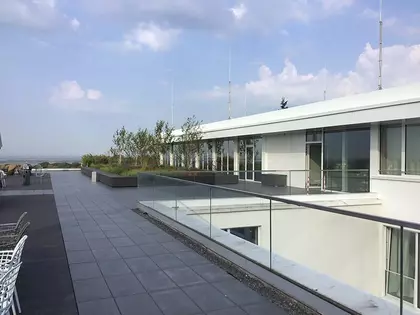
An existing flat roof and a corner-positioned pitched roof, whose roof truss was professionally dismantled before the addition, served as the basis for the planned extension. By adding floors to two wings of the clinic complex, an additional usable area of around 600 m² was created.
An additional usable area of around 600 m² was created by adding floors to two wings of the clinic complex. This was based on an existing flat roof and a pitched roof positioned in the corner, whose roof truss was professionally dismantled before the extension was built. "The framework for the new floor is a lightweight steel construction which, according to the fire protection concept, had to be F90-quality protected. Our expertise in fire protection was therefore required at a very early stage of construction", recalls Marcel Schönberger.
The coordination process with the responsible fire protection expert, as well as the architect and client was accordingly close-knit. Together with technicians from the fit-out partner RIGIPS, solutions were developed for many details, convincingly meeting the comprehensive fire protection concept. "The first step was to reinforce the entire steel framework. For this, we enclosed all columns and beams with the special fire protection boards Rigips Glasroc F," says Marcel Schönberger. To avoid loading the ceiling above the second floor statically, steel girder reinforcements were installed in the raised floor cavity, on which the steel roof structure could then be mounted. These, too, were reinforced with Glasroc F according to the U/A ratio. The fit-out team carried out the three-sided cladding of these steel beams in consultation with the fire protection expert and RIGIPS, based on the manufacturer's BS23GR system. The floor connection of the fire protection boards was tightly sealed using VARIO joint filler at the board thickness. "Since the installation of the facade was scheduled for a later construction phase, we temporarily protected all clad steel beams exposed to the weather with a weather-resistant film wrapping."
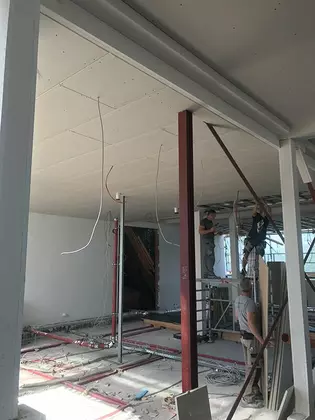
All columns and beams were enclosed with the special fire protection boards Rigips Glasroc F.
A free-standing F90 fire-protection ceiling and Rigips Die Weiße as the visual ceiling are shown.
Gypsum fibre boards as a substrate for ETICS
Since the external facade has an offset of about 300 mm and some of the floor-mounted steel beams are thus also outside the building, these were reinforced for fire protection using brackets and strips of Glasroc F. "The main challenge here was ensuring compatibility with the selected external thermal insulation composite system (ETICS) for the facade. As the approval for the system does not include glass fleece-reinforced gypsum boards like Glasroc F, we applied an additional top layer of 12.5 mm-thick Rigidur H gypsum fibre boards. This then served as the adhesive substrate for the non-combustible mineral wool insulation boards."
The steel beams in the built-up external wall also required F90 cladding. By doubling up with Glasroc F board strips and interior Glasroc F boards, which were attached directly inside the steel beams, this installation situation was also solved in consultation with the expert. The cladding was made twice as thick as required by the U/A value of the beams, since the steel beams were wider than the exterior masonry. The new floor also extends about one meter beyond the second floor between two building axes. The structural preliminary design had specified a steel plate there to absorb traffic loads. "To ensure the fire-resistant quality of the floor ceiling in these areas as well, a floating screed made of Rigidur screed elements was applied on top and a suspended fire-resistant ceiling was installed below," says Marcel Schönberger.
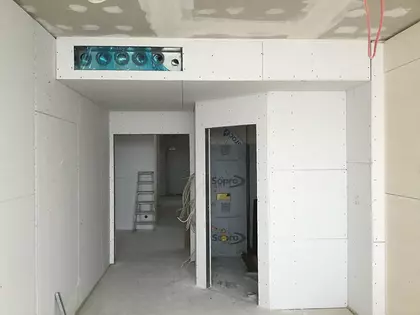
For the partitions between patient rooms, a fire resistance rating of F30 and a sound insulation rating of at least R’w 53 dB were required. The walls were built according to the Rigips System MW22RBWB: a double stud wall (2 x CW 50) with mineral wool insulation inside and cladding with Rigips construction boards RB (first layer) and Rigips Die Weiße (second layer). The latter also made the Q3 finish easier to achieve.
Free-standing F90 fire-protection ceiling and Rigips Die Weiße as the visual ceiling
The trapezoidal sheet metal ceiling of the new upper floor received a free-standing F90 fire-protection ceiling for fire exposure from below. For this, the team led by Marcel Schönberger mounted base profiles using Rigips Klick Fix direct fasteners, which in turn were fixed to the sheet metal using Rigips FN fastening screws. A layer of non-combustible mineral wool was then inserted, followed by installation of the load-bearing profiles. For cladding, one layer of Rigips Die Dicke (25 mm) and one layer of Rigips fire protection boards (15 mm) were used. "This variant had the advantage that with the 15 mm thick fire protection board top layer, the proportion of joints to be filled was lower than with the usual 2 x 20 mm boards of Rigips Die Dicke. Under the fire protection ceiling, a visual (exposed) ceiling was then additionally mounted, in some cases as a self-supporting ceiling, in others as a suspended construction. Since all ceilings were to be finished in Q3, we chose Rigips Die Weiße for this. These special boards come from the factory with an especially bright liner and have beveled edges on all four sides. This creates a joint bed at the cross joint, allowing for flush filling and resulting in perfectly flat surfaces with the highest crack resistance and significantly improved joint strength."
Fire protection solution for an expansion joint
Special attention was required for a structurally necessary building expansion joint between the two building complexes constructed in different years. This joint also needed to be effective in terms of fire protection. Since the installation areas were at different heights and there was a steel component directly in the area of the joint, this was first clad with Glasroc F. Due to additional steel components, it was decided in consultation with the fire protection expert to construct two separate shaft walls, made entirely from Glasroc F, to separate the sections. The necessary cross-bracing in the substructure was also clad with Glasroc F over a length of 500 mm, as were all steel beams between the two shaft walls.
All top connections of the walls to the fire-resistant ceiling cladding of the roof structure were designed as sliding (floating) ceiling connections. Any penetrations through the walls therefore had to be installed at a minimum distance of 14 cm from the suspended ceiling, to be located outside the floating area. This requirement made it necessary to relocate some conduits afterward.
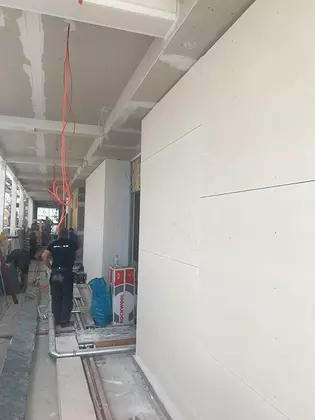
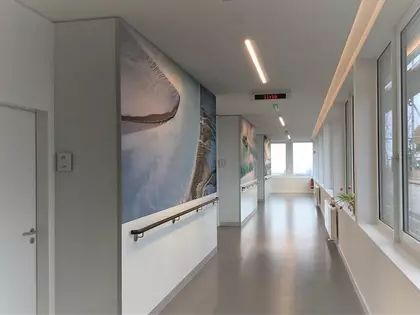
The partitions between the corridor and the patient rooms were to be built in F90 as double stud walls—clad with Rigips fire protection boards and Rigips Die Weiße. To ensure the safe later installation of handrails on the corridor walls, traverses made of Rigidur gypsum fiber boards, with an approved load transfer of up to 1.5 kN, were also mounted at the required height.
Load-bearing wet room constructions in bathrooms
In addition to the extensive fire protection measures, the fit-out team implemented a range of other constructions that had to meet special requirements. For example, in the bathrooms of the patient rooms, a high-performance hybrid construction was used: all walls first received a cladding with the robust dry construction board Rigips Habito, which allows for easy load mounting regardless of the substructure. This means that mirror cabinets, towel holders, and other fixtures can be installed according to need and preference. The final layer is formed by the moisture-resistant board Rigips Glasroc X. "The specified moisture exposure class actually only required cladding with impregnated gypsum boards. However, since none of the shower areas have windows, we recommended the client use these higher-performing, glass fleece-reinforced wet room boards," explains Marcel Schönberger. Then, all surfaces in the wet areas were sealed according to the processing guidelines and tiled up to a height of 1,600 mm. The upper wall areas were finished with VARIO H joint filler and then painted.
Various partition wall structures and built-in elements
For the partitions between patient rooms, a fire resistance rating of F30 and a sound insulation rating of at least R’w 53 dB were required. The walls were built according to the Rigips System MW22RBWB: a double stud wall (2 x CW 50) with mineral wool insulation inside and cladding with Rigips construction boards RB (first layer) and Rigips Die Weiße (second layer). The latter again made the Q3 finish easier to achieve.
The partitions between the corridor and patient rooms were to be built in F90 as double stud walls – clad with Rigips fire protection boards and Rigips Die Weiße. For soundproofing reasons, the shell distances were increased here and the resulting void was additionally filled with non-combustible mineral wool (ISOVER Akustic TP 1). For improved fire protection, the profiles were further connected at three points with board strips. "To ensure that handrails could be securely installed on the corridor walls later, we additionally integrated traverses made of Rigidur gypsum fibre boards, with an approved load transfer up to 1.5 kN, at the required height in the substructure. In other corridor areas, the wall structures were modified for specific requirements. For instance, an EI30-SM fire curtain was installed above the reception counter to separate the nurses' station. At the entrance to the stairwell, the wall accommodates a T30-RS sliding fire door, for which we obtained individual approval."
In addition to the stringent fire protection requirements that Trockenbau Schönberger had to meet, the expert jurors of the 12th Rigips Trophy 2019 I 2020 were particularly impressed by the variety and quality of the special solutions developed. They praised both the commitment of the drywall team, which invested a great deal of know-how in professional execution and creative solutions, and the exemplary collaboration with the fire protection expert and the responsible planners.
Robust corners hold up to even a hectic hospital routine
Last but not least, the new premises of course had to be visually convincing as well: in the corridor areas, for example, cove lighting for daylight LED strips was installed according to the architect's plan to create a harmonious lighting effect. All upstands and shadow gaps were finished to the highest quality with the self-adhesive Rigips Göppinger edge protection profile AquaBead L-Trim. All 90° external corners received edge protection made of the likewise self-adhesive, extremely robust Rigips AquaBead edge protector. "And when it comes to the occasionally hectic hospital routine, extremely robust corners are really something a builder doesn’t need much convincing about", says drywall professional Marcel Schönberger from experience.
In addition to the stringent fire protection requirements that Trockenbau Schönberger had to meet, the expert jurors of the 12th Rigips Trophy 2019 I 2020 were particularly impressed by the variety and quality of the special solutions developed. They praised both the commitment of the drywall team, which invested a great deal of know-how in professional execution and creative solutions, as well as the exemplary collaboration with the fire protection expert and the responsible planners.
Project Data
Client: Tabea Hospital GmbH & Co. KG, Hamburg
Design: WAGENKNECHTARCHITEKTEN, Hamburg
Fire Protection Expert: Expert Office Sander / Donislawski, Hamburg
Fit-out Contractor: Trockenbau Schönberger, Klein Pampau
Drywall Systems Consultant: Dennis Pietrzyk, Saint-Gobain Rigips GmbH
SAINT-GOBAIN RIGIPS GMBH
RIGIPS. You have the solution for everything. #RigipsForEverything
Recognised as a system provider by construction professionals for its high-quality drywall solutions, RIGIPS offers a wide range of gypsum and speciality boards, Rigidur gypsum fibre boards, profiles, accessories and high-performance fillers and joint compounds. These tried-and-tested solutions have proven their effectiveness in interior and exterior drywall construction. In particular, our range of systems for weather-protected façade constructions makes us the ideal partner for timber frame construction projects. With its ever-expanding range of products for healthy living and its highly effective fire and sound protection systems, the manufacturer delivers maximum safety and comfort. This extensive product and system portfolio is complemented by a broad range of services and personal expert consultation, providing valuable support in planning and executing even the most demanding construction projects. At the same time, RIGIPS is committed to environmental responsibility, focusing on sustainable climate protection and the conservation of natural resources. For instance, gypsum board recycling solutions are closing material cycles, and packaging made from recycled materials is reducing the need for primary raw materials. RIGIPS has been recognised multiple times as a Brand of the Century and is one of the most important brands for modern drywall solutions in the German market. The company is part of the international Saint-Gobain Group.
In a nutshell: Rigips® – building better for people and the environment.
ABOUT SAINT-GOBAIN
As a global leader in sustainable lightweight construction, Saint-Gobain develops, manufactures and distributes materials and services for the construction and industrial sectors. Its integrated solutions for renovating public and private buildings, lightweight construction and decarbonising the construction and industrial sectors are developed through continuous innovation. These solutions offer both sustainability and performance. The Saint-Gobain Group is guided by its purpose: "MAKING THE WORLD A BETTER HOME".
- €51.2 billion in sales in 2022
- More than 168,000 employees, represented in 75 countries
- Committed to achieving carbon neutrality by 2050
Find out more about Saint-Gobain at www.saint-gobain.de
and follow us on LinkedIn Saint-Gobain Germany.
Further information:
SAINT-GOBAIN RIGIPS GMBH
Schanzenstraße 84
40549 Düsseldorf
P.O. Box 11 09 48
40509 Düsseldorf
Phone 02 11 / 55 03-0
Fax 02 11 / 55 03-208
[email protected]
Editorial contact:
baumarketing.com GmbH
Christoph Tauschwitz
Laubenweg 13
D-45149 Essen
Tel.: +49 201 2202 400
Fax: +49 201 2202 460
[email protected]