

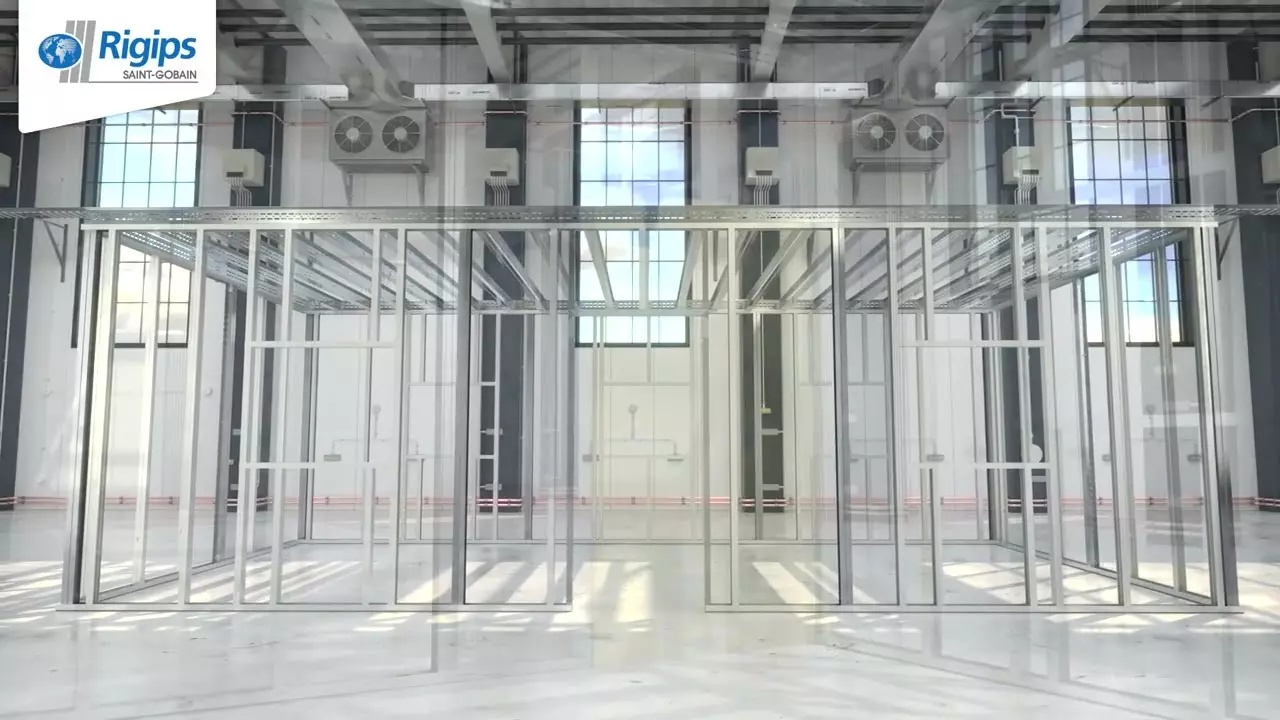
RIGIPS room‑in‑room solutions – selected reference projects
Representative room‑in‑room solutions in drywall construction by RIGIPS – at a glance
Universum® Bremen: Science You Can Touch

Photos: Universum® Bremen, OPTA Trockenbau GmbH
Awaken curiosity, spark amazement, inspire enthusiasm and provoke questions. These are the goals of Universum® Bremen, a unique science and hands-on museum where children, teenagers and adults can interact with scientific phenomena in playful and exploratory ways. As part of a comprehensive modernisation project, 11 free-standing spatial cells of various sizes and shapes, with perfectly crafted surfaces, had to be completed within a construction time of only three weeks. To avoid adding additional fire loads, wooden constructions were prohibited. The expansion team found an equally practical and secure solution in RigiRaum systems.
The details of the individual spatial cells were discussed in an initial step in collaboration with a Rigips technician, followed by the creation of preliminary static calculations. All walls were designed to be 125 mm thick using 75 mm profiles. To support the weight of the ceiling and for stability reasons, the outer profiles were replaced with "L" and "XL" supports. According to the static calculations, some spatial cells were reinforced in the first layer with robust Rigidur H gypsum fibre boards, while others used hard gypsum boards Rigips Die Harte. These were followed by a second layer of Rigips RB construction boards. Another key advantage of RigiRaum systems is their high degree of flexibility, which allowed trapezoidal and polygonal floor plans to be realised in Universum Bremen.
Contractor: OPTA Trockenbau GmbH, Schessinghausen
Weser Renaissance Museum Schloss Brake: optimising event and exhibition facilities with modern drywall solutions

Photos: Landesverband Lippe, Saint-Gobain Rigips GmbH
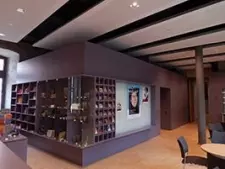
Between the beginning of the Reformation and the Thirty Years' War, the Weser region experienced a real "construction boom". Evidence of this can be seen in the town hall and residential buildings of the historic Hanseatic city of Lemgo. In the suburb of Brake, the former County of Lippe's Renaissance residence has been preserved: Schloss Brake, which has been home to the Weserrenaissance Museum since 1989. As part of the renovation to make the building accessible to all and to optimise the rooms for events and exhibitions, new sanitary facilities were constructed as a room-in-room system.
Due to the large number of ventilation ducts, installations and ceiling sails, it was not possible to attach the walls of the individual spatial cells to the raw ceiling. Additionally, the RigiRaum system had to be accessible from above for maintenance purposes and had to have a load-bearing capacity of at least 150 kg/m². The spatial cells needed to be extremely robust and offer excellent soundproofing. Most importantly, loads needed to be able to be attached to the walls from both inside and outside without prior reinforcement using trusses or OSB boards. To meet these requirements, the drywall company opted for a mixed construction approach. First, a layer of Rigips Die Harte was installed, followed by a layer of the Rigips Habito Habito drywall board. This board enables heavy loads to be easily attached using simple screws, eliminating the need for additional reinforcements and making the walls ideal for exhibitions. Finally, to provide stiffness and a walkable surface, durable wooden boards 22 mm thick were placed on top of the ceiling to distribute loads and secured to the UA profiles at 250 mm intervals. These boards spanned at least two fields and were installed in a staggered layout.
Contractor: Baumanagement Andrä, Blomberg
Modern sports facility construction: multi‑faceted interior fit‑out of a sports hall in Bühl, Baden
Photos: KARA Trockenbau GmbH
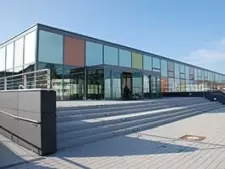
"Form follows function": this design principle is particularly relevant in the construction of sports facilities, where the focus is always on functionality and purpose. Every space is designed to serve a specific purpose. A modern sports centre in Bühl shows that high functionality does not have to compromise appealing aesthetics. The complex includes a state-of-the-art, three-court sports hall with ancillary rooms, as well as a separate gymnastics hall for equipment.
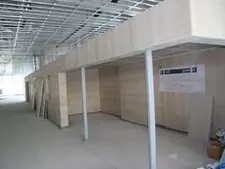
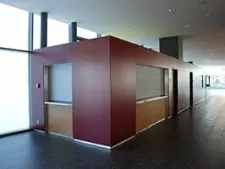
The sports facility has been transformed into a full-scale event centre with fixed cloakroom and catering areas. These were constructed as room-in-room systems. The complete wall substructure was built as a load-bearing, self-supporting framework using steel profiles. The four-sided walls, which are around 2.70 metres high, and the two internal partition walls, which total around 145 m², were double-layered with Rigidur H gypsum fibreboards. This gives the entire structure high stability, and the robust surfaces of the gypsum fibreboards can easily withstand the stresses of well-attended events. In the serving area of the gastronomic section, the walls were designed with openings measuring 3 x 2.20 m and 1.30 x 2.20 m for serving visitors. I don't think the specifications were marketed as "RigiRaum" at the time — do they match today's system standards?
Contractor: KARA Trockenbau GmbH, Baden-Baden
Creativity by Frank O. Gehry in steel and gypsum: the MARTa Museum of Contemporary Art and Design in Herford

Photos: MARTa Museum
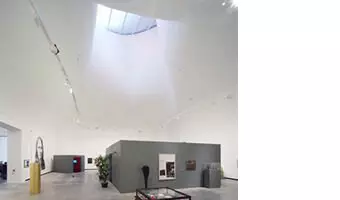
The East Westphalian city of Herford constructed a spectacular architectural complex designed by Frank O. Gehry on a site of around 8,000 m² to house the MARTa Museum of contemporary art and design. The dynamic, organic spatial structures conceived by one of America's most prominent architects presented major challenges for the finishing team. Wherever possible, interior right angles were eliminated. Straight lines are so rare that even passing from one exhibition room to another becomes a dramatically staged experience. Spanning approximately 2,500 m² of exhibition space, the MARTa Museum showcases paintings and sculptures by contemporary artists across four gallery rooms arranged around a 22-metre-high dome. The entire interior was designed using modern drywall systems from RIGIPS.
Visually "counterbalanced," the rounded, organic wall and ceiling forms are complemented by several room-in-room units that function as small exhibition areas "within the larger space." The ideal solution for such constructions? Flexible, lightweight, and rapid-to-implement RigiRaum systems! These room-in-room systems are executed by RIGIPS with reliable drywall techniques and rely exclusively on standard components such as Rigips profiles, gypsum boards, and joint compounds. The key advantage: special profiles or other customized components are unnecessary. Since the required components are typically readily available in specialist stores or easily obtainable, RigiRaum projects can also be implemented at short notice. Depending on the requirements, the room-in-room system can be designed to stand freely, in a corner, or along solid walls. Coupling multiple RigiRaum units is also easily achievable.
Contractor: UNDKRAUS Bauaktiengesellschaft, Berlin (formerly Mänz & Krauss Ausbau, Berlin)