
Rigips fire wall
Fire‑resistant drywall walls for separating fire compartments.
RIGIPS has been a successful provider of lightweight firewalls for many years and is thus considered one of the true pioneers of this construction method, despite the fact that structural fire protection and its regulations are constantly subject to change.
We are providing you with an update on the proofability of Rigips fire walls, which has been affected by the VVTB requirements (Administrative Regulation for the Technical Building Code).
Fire walls limit fire areas
The aim of the regulation is to restrict the spread of fire to other buildings or sections of buildings. This type of delineation enables effective firefighting operations to be carried out within specific spatial boundaries. Special requirements are placed on the construction of firewalls. Their location and quantity are defined in the fire protection concept. Internal applications typically include separating stairwells (starting from building class 4) and cases where minimum distances to property borders are not met, as well as industrial construction.
The rules apply...
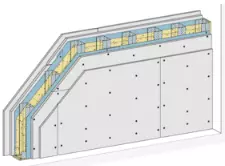
- Fire walls must also be fire-resistant under additional mechanical stress.
- External building walls must be constructed as firewalls if the distance to the property border is less than 2.50 m.
- Fire walls must consist of non-combustible building materials.
- Openings in firewalls are generally not permissible.
- Fire walls must not be interrupted with combustible building materials.
- Fire walls must generally extend 30 cm above the roof or be constructed with plates projecting 50 cm in a fire-resistant design. For buildings in classes GK 1-3, an execution up to just below the roof lining is sufficient.
- Fire walls must be aligned vertically in all stories.
- In buildings that meet at an angle, the distance of the firewall from the inner corner must be 5 m.
Photo above: Montblanc House, Hamburg, Photographer: Roland Halbe Fotografie, Stuttgart
This page was updated in January 2026.