

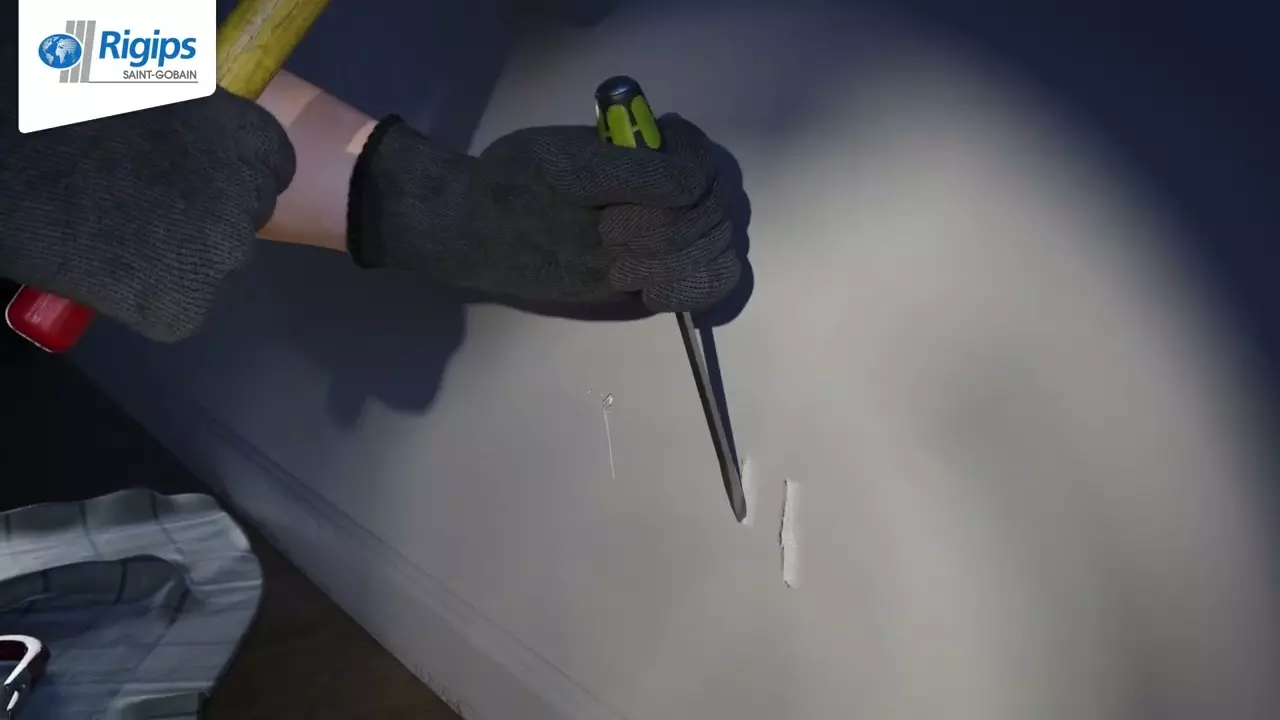
Burglar‑resistant drywall constructions
Tested safety from RIGIPS
"The home is inviolable," as stated in Article 13 of the Basic Law of the Federal Republic of Germany. However, burglars repeatedly target not only homes, but also public and private spaces. Furthermore, according to Section 243 of the German Penal Code (StGB), breaking into a building or individual rooms constitutes a particularly serious form of theft. Although the number of home burglaries has decreased steadily in recent years, there is still a need for burglary protection.
In addition to stealing valuables, perpetrators often cause property damage, costing several hundred million euros annually. Therefore, preventive measures for burglary protection play a crucial role in keeping such unwelcome visitors at bay.
Alongside technical equipment used for monitoring or deterrence, experts and insurers are increasingly advocating the use of building constructions that can resist burglary attempts for as long as possible. Tested drywall systems are a reliable and cost-effective security solution.
The burglar-resistant properties of building components are tested and classified according to the European standard DIN EN 1627, "Doors, windows, curtain walling, grilles and closures – Burglar resistance – Requirements and classification". This standard describes these properties. Currently, there is no specific testing standard for building parts incorporating these components. However, some testing facilities also test wall components based on DIN EN 1627, but they may classify them according to their own criteria. This results in different classifications of building parts for burglar resistance that cannot easily be compared.
Until 2011, the burglar-resistant properties of building components in Germany were described using the abbreviation "WK" for "Widerstandsklasse" (Resistance Class). Following the introduction of the current version of the European standards, the terminology has been standardised. While the English term "resistance class" translates as "Widerstandsklasse" in German, the abbreviated classification "RC" is now used, rather than the previous "WK".
Resistance classes according to DIN EN 1627
When developing a procedure for classifying burglar-resistant building products, we took into account the attack methods employed by burglars and crime statistics from European countries. Commonly used tools were assigned to different classes and grouped into tool sets. The resistance classes listed in DIN EN 1627 reflect the approaches of both opportunistic and experienced, professional burglars. However, the individual resistance classes do not represent a linear increase in security levels. The most significant difference is between RC 3 and RC 4, reflecting a shift between the two perpetrator groups.
The Resistance classes RC 1 to RC 3 consider burglary attempts typically carried out by opportunistic offenders who exploit opportunities without expecting a particularly high or specific reward. Excessive force, noise and unnecessary risk are avoided, and the tools used are simple hand tools. As the risk of discovery for the burglar increases minute by minute, sufficient resistance often leads to the burglary attempt being abandoned.
The Resistance classes RC 4 to RC 6 consider experienced and professional burglars with specific targets and detailed knowledge of the expected loot. Such burglaries are usually pre-planned and associated with organised crime, as the burglars have knowledge of the targeted objects, components and construction types. Avoiding noise is of lesser importance, and attack methods are adapted to the available time frame.
| Resistance Class | Attack Methods (Excerpt from DIN EN 1627:2011-09; Table C.1) |
| RC 1 | Opportunistic burglars attempt to gain access using simple tools and physical force, such as kicking or applying pressure with their shoulders. They exploit opportunities without knowing the resistance level of the target or how much loot to expect. Burglars have little time, avoid making noise and are only minimally willing to take risks. |
| RC 2 | The opportunistic burglar uses simple tools, such as screwdrivers and pliers, to gain access. They exploit opportunities and have only limited knowledge of the likely level of resistance of the target or the expected value of the goods. |
| RC 3 | The burglar can exert more force using a crowbar. They have specific information about the potential resistance level of the target and the likely value of the goods inside. While the burglar is willing to take risks, they must also consider time and noise. |
| RC 4 | An experienced burglar will also use tools such as a heavy hammer, axe or chisel, or a cordless screwdriver. They expect a reasonable reward and are determined to gain access. They are less concerned about making noise and are willing to take greater risks. |
| RC 5 | The highly experienced burglar uses power tools such as drills, hole saws, jigsaws and angle grinders. They expect a reasonable reward, are determined to gain access and are well organised. They are only slightly concerned about making noise and are willing to take high risks. |
| RC 6 | The highly experienced burglar uses splitting hammers and powerful tools such as drills, saws and large angle grinders. They expect a correspondingly high reward, are determined to gain access and are extremely organised. |
Table: Expected attack methods and attack durations
When developing a procedure for classifying burglar-resistant building products, we took into account the attack methods employed by burglars and crime statistics from European countries. Commonly used tools were assigned to different classes and grouped into tool sets. The resistance classes listed in DIN EN 1627 reflect the approaches of both opportunistic and experienced, professional burglars. However, the individual resistance classes do not represent a linear increase in security levels. The most significant difference is between RC 3 and RC 4, reflecting a shift between the two perpetrator groups.
The three testing criteria for burglary resistance
The DIN EN 1628 testing standard "Test methods for determining resistance under static load" is aimed at testing building components, rather than building parts themselves. Nevertheless, its testing requirements can be applied to drywall constructions. During testing, the component is installed in a testing frame and pressure is applied at various points using a pressure stamp. For a metal stud wall, this generally includes the anchoring points to the building structure as well as areas between or on the profiles. The test load depends on the desired resistance class.
The testing standard DIN EN 1629 "Test methods for determining resistance under dynamic load" simulates physical attacks (e.g., shoulder pushes, kicks) without the use of tools. Similar to static testing, the component to be tested is installed in a test frame and subjected to impact stress using a pendulum test device. Impact stresses are applied once to each corner and three times to the centre of the test specimen. The test specimen must not fail during these impacts. The pendulum test device consists of two tyres suspended by a rope with a total mass of 50 kg. The drop height [h] depends on the desired resistance class.
The DIN EN 1630 testing standard "Test methods for determining resistance to manual burglary attempts" is the most practically relevant. Depending on the required resistance class, the burglar is equipped with various tools that are typical of those used by the perpetrator groups described in Table 2. Preliminary tests are conducted to identify potential weak points in the component. These tests can be performed at any location using any tools from the specified tool set. During the subsequent main test, a burglary attempt is made at the suspected weak point of the component. The test is passed if the tester is unable to create an opening of defined dimensions that can be passed through.
Burglar-resistant drywall systems
Burglar-resistant construction is simple and cost-effective using drywall products that are system-tested and approved. The manufacturer RIGIPS has specially labeled its burglar-resistant systems in the planning compendium "Planning and Building." For burglar-resistant wall constructions, specific hard gypsum boards such as "Rigips Die Harte," "Rigips Habito," and the particularly robust gypsum fiberboards "Rigidur H" are suitable.
Systems with additional steel sheet inserts
Rigips metal stud walls can be fitted with additional steel sheet inserts to meet the requirements for burglar-resistant components. These systems have been tested for their burglar-resistant properties at a testing facility and classified accordingly based on their performance:
For wall constructions and connection details with one additional steel sheet insert per wall side, the expert report No. 16-004382-PR04 provides documentation for Resistance Class RC 2.
Request test certificate for System No. EW13DH!
Request test certificate for System No. EW13RH!
For wall constructions and connection details with two additional steel sheet inserts per wall side, the expert report No. 16-004382-PR03 provides documentation for Resistance Class RC 3.
Request test certificate for System No. EW14DH!
Request test certificate for System No. EW14RH!
Systems with Rigips Habito
Rigips metal stud walls equipped with the robust "Rigips Habito" board can meet the requirements for burglar-resistant components with only minimal additional measures, even without additional steel sheet inserts. The advantage: both installation effort and the cost for steel sheet inserts are eliminated. These systems have also been tested for their burglar-resistant properties at a testing facility and classified based on their performance:
For wall constructions with Rigips Habito and the regular profile spacing of 625 mm, the conformity certificate No. TT-254/2023 provides documentation for Resistance Class RC 2.
Request test certificate for System No. EW12HA!
For wall constructions with Rigips Habito and a reduced profile spacing of 312.5 mm, the conformity certificate No. TT-255/2023 provides documentation for Resistance Class RC 3.
Request test certificate for System No. EW12HA!
For double stud wall constructions with Rigips Habito and a reduced profile spacing of 312.5 mm, an additional steel sheet board, and a rebar mat in the profile space, documentation for Resistance Class RC 4 is provided.